Parents often assume that the top 11 Plus candidates are simply the brightest children in the room. In practice, tutors usually observe something more useful and more encouraging. The pupils who make the most consistent progress are rarely defined by raw ability alone. They are more often distinguished by habits: how they approach difficulty, how they respond to mistakes and how consistently they apply good methods over time.
Why Habits Matter As Much As Ability
Experienced tutors tend to see the same behavioural markers recurring in children who steadily move towards the top end of 11 Plus performance. These markers are not fixed personality traits. They are habits of learning, and habits can be developed.
This matters because the 11 Plus rewards more than knowledge. Children need to read carefully, think under pressure, adapt methods, recover from mistakes and apply familiar techniques in unfamiliar settings. A bright child who rushes, panics or resists feedback may underperform, while a slightly less naturally quick child with stronger learning habits may improve steadily and eventually overtake expectations.
For families thinking more broadly about preparation, How to prepare for 11 Plus and independent school assessments provides useful further reference on building both academic and exam-readiness skills.
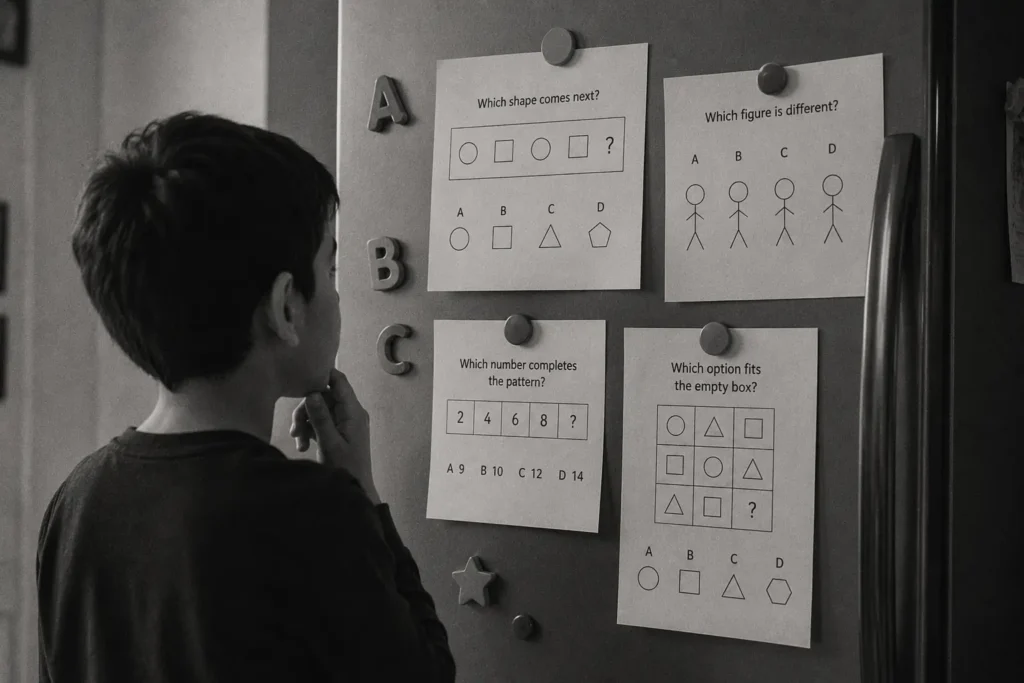
Six Markers Tutors Watch For
| Marker | What tutors see | How parents can help develop it |
| Controlled approach | The child reads and thinks before solving | Ask: “What is the question really asking?” |
| Mistake reflection | The child wants to know why something went wrong | Ask: “What caused that error?” |
| Method adaptability | The child is willing to try a different approach | Praise flexible thinking |
| Engagement under difficulty | The child persists before seeking help | Allow thinking time before stepping in |
| Pattern awareness | The child recognises familiar question types | Name question types during review |
| Method transfer | The child applies learned methods elsewhere | Ask: “Where else could this method work?” |
A controlled approach is one of the strongest early indicators of future progress. When faced with an unfamiliar question, high-performing pupils tend not to rush immediately into an answer. They pause, read carefully and begin with a sense of method. Even if they do not solve the problem immediately, their thinking is structured rather than frantic.
Tutors also notice how children respond when they make mistakes. Some pupils want to know the correct answer and move on. Others become curious about the mistake itself. They want to understand what went wrong and why. That reflective habit is powerful because it turns every mistake into useful information rather than a small failure.
The Education Endowment Foundation’s metacognition and self-regulation evidence places strong emphasis on these reflective learning habits, identifying them as among the highest-impact educational approaches.
The Role Of Consistency And Focus
Consistency is often a stronger predictor of progress than ability. Children who work in short, regular sessions tend to make steadier gains than children who rely on occasional bursts of heavy work.
A focused forty-minute session, completed four or five times a week, will usually produce better long-term development than a single long, distracted session on the weekend. That is because learning strengthens through repetition, familiarity and routine. Patterns become easier to recognise, methods become more automatic, and confidence grows from repeated successful application.
A strong weekly rhythm for many Year 4 and Year 5 pupils might include several shorter weekday sessions, one longer weekend paper or mixed practice session, and one review session focused on mistakes rather than new content. How many hours should my child study for the 11 Plus? may be useful for families trying to build a sustainable routine.
The Learning Scientists have repeatedly highlighted retrieval practice as one of the strongest evidence-based ways to strengthen learning. Revisiting, recalling and reviewing knowledge helps children retain methods far more securely than constantly moving on to new material.
The National Literacy Trust also continues to emphasise the long-term academic value of regular reading habits, particularly for vocabulary development, comprehension and confidence with language-rich material.
How Top Students Approach Practice
One of the clearest differences tutors observe is how stronger pupils think about practice itself. Less successful students often treat practice as something to complete. Top-performing students treat practice as information.
If they answer a question incorrectly, they naturally begin analysing the cause. They ask whether they misunderstood the concept, misread the wording, rushed, or used an inefficient method. That thought process creates rapid improvement because mistakes become diagnostic rather than discouraging.
They also apply feedback more effectively. When shown a stronger method, they actively try to use it the next time a similar question appears. Over time, that creates method transfer: the ability to apply one learned technique across many contexts.
That matters enormously across different exam routes, whether a child is preparing for GL Assessment-style grammar papers or adaptive formats such as the ISEB Common Pre-Test.
Attitude And Mindset In 11 Plus Preparation
Attitude matters, but not in the vague way it is often discussed. What tutors usually notice is the difference between pupils who see difficulty as a judgement on their ability and pupils who see it as part of learning.
A fixed mindset might sound like “I am not good at English” or “I always struggle with this type of question”. A growth mindset sounds more like “I cannot do this yet”, “I need a different method”, or “I need more practice here”.
That shift in language matters because it changes how children respond to challenge. Difficulty stops being proof of inability and becomes part of the learning process.
Mindset Works, drawing on the work of Carol Dweck, has helped bring this idea into mainstream education by showing how beliefs about learning can influence resilience, persistence and long-term progress.
Confidence is often built in this way, not through reassurance alone, but through visible evidence of progress.
How Parents Can Support These Traits
Parents have an enormous influence over whether these habits develop. Routine is one of the simplest and strongest levers. A regular study time, a quiet study space and predictable expectations help children approach work with calm consistency.
The questions parents ask also matter. It is often more useful to ask what part was hardest, why an error happened, what the child might try differently next time, or which question type the problem resembled, rather than focusing immediately on the score.
Those questions encourage reflection rather than performance anxiety.
Praise matters too. Children benefit more from hearing that they stayed with a difficult problem or changed method when the first approach did not work than being praised for getting full marks. This helps them value persistence, flexibility and technique.
YoungMinds also highlights the importance of balancing academic challenge with wellbeing, particularly when children are under sustained pressure. Calm support usually produces better long-term resilience than high-pressure environments.
Parents who are worried that their child is bright but inconsistent may also find Why bright children sometimes fail the 11 Plus useful.

What Tutors Do Not Need To See
It is just as useful to know what tutors are not measuring. Parents sometimes worry about the wrong signals and miss the ones that actually predict progress. The points below are common assumptions that experienced tutors quietly set aside when working with a new child.
Instant Success
Top students do not always get everything right immediately. In fact, tutors often learn more from how a child handles a difficult question than from how quickly they complete an easy one.
Perfectionism
Perfectionism can sometimes hold children back because they become afraid to guess, experiment or move on. Strong candidates usually develop accuracy without becoming rigid.
Endless Work
Tutors are not usually looking for children who complete the most work. They are looking for children who learn from the work they complete. Quality of review matters more than sheer volume.
Adult-Style Answers
Especially in English and interview-style work, tutors are not trying to turn children into miniature adults. The aim is thoughtful, age-appropriate confidence, not rehearsed sophistication.
How Lionheart Education Builds Strong 11 Plus Habits
The strongest 11 Plus habits are built gradually through consistent routines, reflective practice and careful guidance. Children do not become top candidates overnight. More often, they develop behaviours that steadily improve how they learn, work, and perform under pressure.
Lionheart Education focuses heavily on building these habits alongside academic knowledge, helping children strengthen consistency, improve reflection and develop the learning behaviours that underpin strong long-term performance.
FAQ’S
-
What do tutors look for in top 11 Plus students?
Tutors repeatedly notice six markers: controlled approach, mistake reflection, method adaptability, engagement under difficulty, pattern awareness and method transfer.
-
Are top students naturally gifted or well prepared?
Both matter, but habits often become the bigger long-term differentiator. Strong learning habits frequently outperform raw ability applied inconsistently.
-
What habits do successful children develop?
Successful children usually develop regular short practice, reflection on mistakes, willingness to try new methods and steady engagement with difficult material.
-
How important is attitude in 11 Plus preparation?
Attitude is highly important because it shapes persistence, resilience and willingness to improve after setbacks. Children who treat difficulty as part of learning usually progress more steadily.
-
Can these traits be developed over time?
Yes. With structured practice and thoughtful guidance, meaningful changes are often visible within eight to twelve weeks.