Non-verbal reasoning improves when children stop seeing NVR as random shapes and start recognising the repeated pattern families behind the questions. The most important levers are learning the main sequences and patterns, practising each one under realistic timing, tracking speed and accuracy, and reviewing every wrong answer to identify the exact pattern-recognition gap.
Why Non-Verbal Reasoning Feels Difficult
Many parents see non-verbal reasoning as mysterious because it feels unlike normal schoolwork. There are no obvious vocabulary lists to learn and no clear syllabus, as there is for Maths or English. That can make NVR feel like an abstract intelligence test, as though a child either naturally has the skill or does not.
That is not how it works. Non-verbal reasoning is highly teachable because it is built around recurring pattern families. Once children understand those, practise them deliberately and learn to recognise them quickly, scores often improve sharply.
GL Assessment uses recurring visual-reasoning families that recur in recognisable forms. The ISEB Common Pre-Test also assesses visual reasoning, though in a computer-based adaptive format. The Good Schools Guide has often noted that children improve most quickly when they stop seeing NVR as random shapes and start seeing recurring systems.
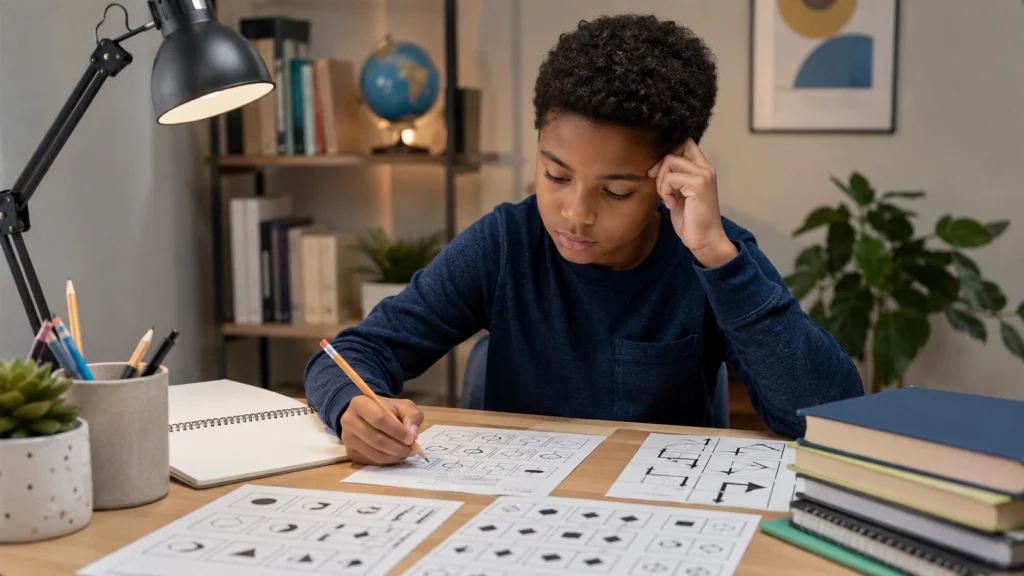
Nvr Pattern Families And Key Techniques
| Family | Technique | Typical time per question |
| Similarities / odd-one-out | Describe features clearly, then eliminate | 15–20 seconds |
| Series | Track one visual feature at a time | 30–40 seconds |
| Matrices | Analyse rows first, then columns | 40–50 seconds |
| Analogies | Identify the A-to-B change, then apply it to C | 30–40 seconds |
| Cube folding | Identify the base and face adjacency | 50–60 seconds |
| Rotation/reflection | Visualise the exact transformation | 30–40 seconds |
Lionheart Education teaches NVR family by family, because most children are not generally weak at non-verbal reasoning. More often, they are weak in one or two specific families, and those weaknesses can be repaired much more effectively when they are identified precisely.
Similarities And Odd-One-Out Questions
Similarities and odd-one-out questions are often among the quickest-win families because children can improve rapidly once they change how they look at shapes. The biggest mistake is glancing at the options and relying on instinct.
A better method is to describe each shape verbally. Children should ask whether the shape has the same number of sides, whether it is filled or unfilled, whether it has been rotated, whether it is symmetrical, whether it has an extra line or a missing corner, whether its size changes and whether the shading follows a rule.
Once children force themselves to articulate what they can see, the hidden structure becomes clearer. They can then eliminate options with greater confidence. If four shapes share one feature and one breaks the rule, the odd one out usually reveals itself quickly.
Top pupils become fast here, often within fifteen to twenty seconds, but that speed comes from clear observation rather than guessing.
Series And Sequence Questions
Series questions are really about identifying what changes from one image to the next. The best approach is feature-by-feature analysis.
Children should ask whether the shape is rotating, reflecting, growing, shrinking, adding parts, removing parts, changing shading or alternating in a repeating pattern. Sometimes two patterns run together, such as a shape changing every image while shading changes every other image. This two-pattern interleaving is where many children get caught.
Once pupils learn to check systematically rather than guessing visually, series scores often improve quickly. NVR series questions provides further reference for families who want to practise this family more deliberately.
Matrix Questions
Matrices often look intimidating because a lot is happening visually, but they become much easier once children learn how to break them down. The safest approach is to analyse rows first, looking for what changes from left to right, and then analyse columns, looking for what changes from top to bottom.
Often, the answer is created by two interacting rules: one across the rows and one down the columns. Common transformations include rotation, reflection, addition of shapes, subtraction of shapes, shading inversion and pattern layering.
Matrices reward calm logic more than speedy guessing. Children who rush into the options too quickly often choose an attractive wrong answer, while children who define the rule first are much more consistent.
Analogy Questions
Analogy questions ask children to understand how one shape changes into another and then apply the same transformation to a new shape. In simple terms, A becomes B, so C must become what?
The key is resisting the urge to jump straight to the answer choices. First, pupils should work out exactly what happened from A to B. The shape may have rotated, flipped, gained a line, lost a section, changed shading or duplicated a feature.
Once the transformation is clear, the same rule applies to C. Children who skip this first step often choose answers that look visually plausible but do not follow the rule.
Cube Folding Questions
Cube folding is one of the hardest NVR families because it demands spatial visualisation. The strongest technique is to identify the base, which is the square that effectively stays still while the others fold around it.
From there, children need to work out adjacency. They should ask which faces touch, which faces can never touch because they sit opposite each other, and whether the visible arrangement in the answer options could actually be formed from the net.
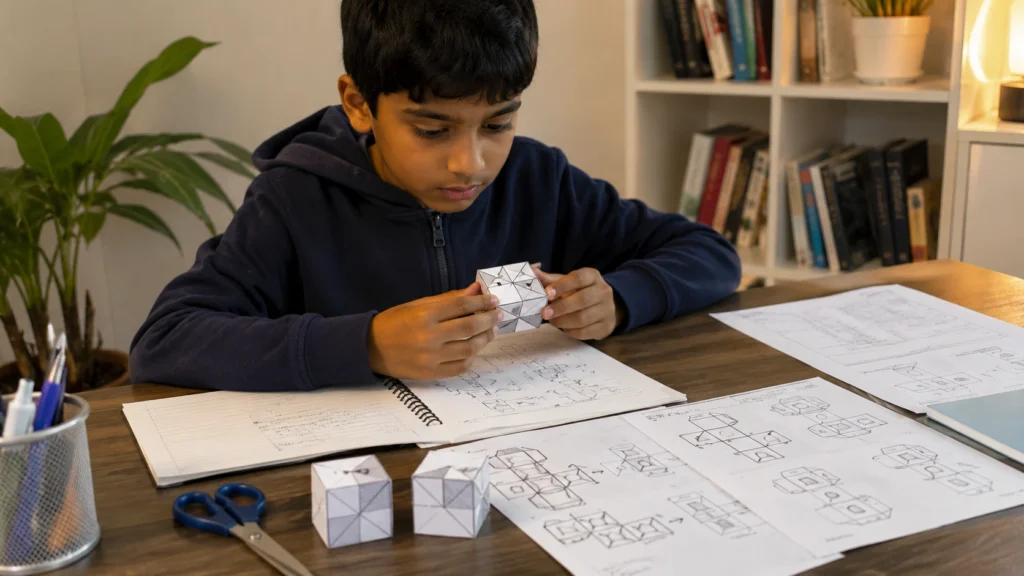
Physical practice helps enormously here. Children should make paper cube nets, fold them, hold them and turn them. That practical work trains the brain much faster than staring at flat diagrams alone. Children who physically build cubes often improve more quickly than children who only complete worksheets.
Bond 11+ has useful cube and spatial reasoning resources, although practical build work should sit alongside book practice. Cube folding questions may also be useful for families wanting to isolate this specific skill.
Rotation And Reflection Questions
Rotation and reflection questions catch many bright children because they almost visualise the transformation correctly. In NVR, close is not enough.
Children should explicitly picture a 90-degree rotation, a 180-degree rotation, a 270-degree rotation, a left-right reflection, and an up-down reflection. These are different operations, and the brain often confuses reflection with rotation under time pressure.
Practising slowly and deliberately builds accuracy first. Speed should come later, once the child can name the transformation and apply it reliably.
Timing In Non-Verbal Reasoning
Bright children often get NVR questions right, but too slowly. That is one of the biggest hidden problems.
A typical NVR section may effectively allow around fifty seconds per question overall. That does not mean every question should take exactly fifty seconds. Easier odd-one-out questions should be quicker, while cube folding or matrix questions may take longer. The key is that children learn when to move on.
If a question takes more than 60 seconds to answer, it is often better to make an educated guess and continue. An unfinished paper can cost more marks than one sensible guess.
Try to build a timing-per-question log because this makes improvement measurable. A child may be accurate in series questions but too slow in matrices, or quick in odd-one-out but unreliable in rotations. Once that is visible, practice becomes much more targeted.
Review Is What Separates Top Candidates
The Education Endowment Foundation Feedback Toolkit regularly highlights the power of deliberate review, and that matters hugely in NVR.
Every wrong answer should be logged by family: rotations, matrices, cube folding, analogies, series or odd-one-out. Patterns quickly appear. Most children repeatedly miss the same two families.
Fix those families, and scores will improve.
Doing a fresh paper without targeted re-drill is often wasted effort. Ten well-reviewed papers beat thirty rushed ones, because improvement comes from understanding why an error happened, not simply from completing more pages.
Resources And Practice
The strongest, widely used resources include Bond 11+, CGP Books, and Schofield & Sims. Each has value, but books alone are not enough unless practice is systematic.
Children should move family by family rather than randomly from page to page. That structure matters because it allows them to build recognition, timing and confidence in one area before moving to the next.
When To Consider A Tutor For Nvr Specifically
A tutor becomes useful when a child has worked through all the main families but still misses some, when timing remains poor, when adaptive computer-based ISEB practice is needed, or when parents are struggling to diagnose the real pattern gaps.
The important point is that tutoring should not simply mean doing more NVR. It should mean identifying exactly which family is holding the child back and repairing that weakness through targeted practice.
How Lionheart Education Tutors Nvr
Lionheart Education teaches non-verbal reasoning through family-by-family drilling, timing logs, targeted weak-family repair, computer-based ISEB-style familiarisation and structured review after every session. That means progress becomes specific and measurable rather than vague.

-
How do you improve non-verbal reasoning for the 11 Plus?
Children improve non-verbal reasoning by learning the main NVR families, drilling each one under timed conditions, tracking speed and accuracy, and reviewing every wrong answer by family. Most children improve sharply once practice becomes systematic.
-
What are the main NVR question types in the 11 Plus?
The main families include similarities, odd-one-out, series, matrices, analogies, cube folding, rotation, reflection and code-based visual patterns. Different exam routes may present these in slightly different ways.
-
How long should each NVR question take?
Around fifty seconds per question is a useful overall benchmark, although simpler questions should be quicker and harder cube or matrix questions may take closer to a minute.
-
Can non-verbal reasoning be improved?
Yes. NVR rewards familiarity, pattern recognition and disciplined timing far more than many families realise. Children who practise family by family and review errors carefully can make substantial progress.