Time out of school is the part we can do something about.



What we do, and what we do not
Lionheart is an education provider. We do not diagnose, we do not treat, and we do not deliver therapy. That work belongs to CAMHS, your GP, a private clinician or an educational psychologist.
What we can do is make sure the education continues while they do it. Missed terms turn into gaps, gaps turn a return into something that feels impossible, and a child who has fallen behind has one more reason not to go back. Keeping the work moving, even slowly, protects the option of returning.
Read our case studiesOur Approach
Slowly, and in this order
We do not push. A session that ends badly sets things back further than a session missed, so the pace is set by the student rather than by the syllabus.






Common situations we support
These are the situations families most often describe when they call. Most involve more than one of them at once.
-
Anxiety & school avoidance
Often it is not the school as a whole but one part of the day: a particular lesson, registration, the corridor between them, the journey in. We work out where the avoidance started, teach at home or online in the meantime, and build the return outwards from the least difficult part.
-
Depression & low motivation
Withdrawal from the work usually comes before withdrawal from the building. Short sessions, the same tutor every week, and tasks set at a level that can actually be finished. Finishing something is the whole point at that stage.
-
Return after treatment or hospital
Students coming back after inpatient care, a period under CAMHS, or treatment for an eating disorder. We coordinate with the clinical team, establish precisely what has been missed, and cover it before a return date is set rather than afterwards.
-
Burnout & academic pressure
Usually in able students, and usually in the year before public exams. The instinct on all sides is to work harder. More often the answer is to reduce the load and protect the subjects that matter most.
-
Difficulty with emotional regulation
Where distress shows up in the lesson itself, as frustration or as shutdown. Sessions are built so a student can pause without the lesson ending, which stops leaving from becoming the pattern.
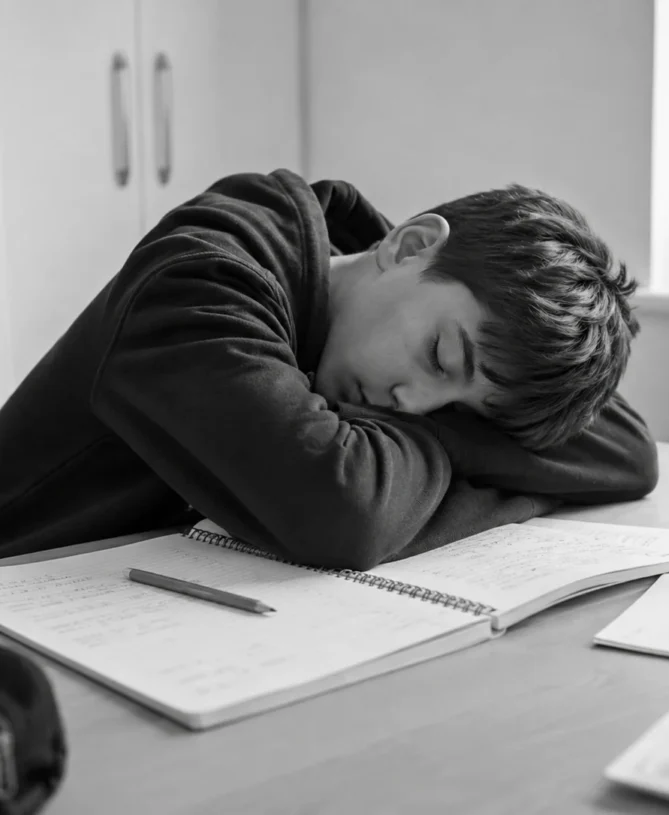

School refusal has a name, and it is not truancy
Emotionally based school avoidance describes a child who wants to be in education but cannot manage the school environment. From the outside it looks like truancy, which is why it is so often handled as though it were.
The practical consequence is attendance. Unauthorised absences accumulate, and at a certain point the local authority has a duty to satisfy itself that your child is receiving a suitable education. Families are frequently dealing with that letter at the same time as everything else.
A structured, recorded programme of teaching changes that conversation. We can show what is being taught, when, and what has been covered, across one-to-one lessons at home, a full homeschooling timetable, or a hybrid arrangement with the school. It also means your child is not losing ground while the rest is being resolved.

Mental Health Support at Lionheart
“We invest a great deal of time at the outset in understanding each young person — their learning needs, their mental health, and the full picture around them. We focus not only on where they struggle, but equally on their strengths and what they do well.”
Sophia Wybourne Managing Director, Lions Campus

Anxiety and school refusal tutors
Steadiness is the qualification that matters most here
We choose tutors who can work at a student’s pace without visible impatience, absorb a cancelled session, and arrive the following week exactly the same. Several have backgrounds in psychology or SEN teaching. Every placement is overseen by Lionheart’s senior education team and reviewed as your child’s situation changes
-
Selection
Enhanced DBS and international safeguarding checks on every tutor. Beyond that we interview for temperament, because subject expertise tells you nothing about how someone handles a student who cannot begin.
-
Working with others
With your consent we coordinate with CAMHS teams, GPs, therapists, educational psychologists and school SENCOs, so everyone involved is working to the same plan.
-
Oversight
Senior consultants review each placement, looking at wellbeing alongside progress. If the match is wrong we change it rather than waiting for the end of term.

I never thought I’d look forward to learning again…
For students rebuilding confidence after anxiety or burnout, lessons aren’t just about grades, they’re about rediscovering curiosity. One week it’s creative writing by the river; another, science through cooking. When learning feels safe, everything changes.
Speak with our consultantsFrequently asked questions:
-
Can my child be tutored while they are unwell?
Yes, and the sessions are built around what they can manage rather than a fixed timetable. That might mean thirty minutes twice a week to begin with. We plan with the clinical context in mind and adjust as it changes.
-
Does Lionheart provide therapy or treatment?
No. We are an education provider, not a clinical service, and we do not diagnose, treat or deliver therapy. Clinical support usually starts with your GP and the NHS children and young people’s mental health services. Young Minds and Place2Be both publish useful information for families.
-
What is EBSA?
Emotionally based school avoidance. It describes a child who is emotionally unable to attend rather than unwilling, which is what separates it from truancy. Most students we teach in this situation want to keep learning. It is the building they cannot manage.
-
Can you work with our therapist or medical team?
Yes, with your consent, and it works considerably better when we do. We take the clinical plan as given and build the teaching around it, then report back on what we are seeing in sessions.
-
What if my child has been out of school for months?
Common, and recoverable. We establish what has actually been missed rather than assuming the whole year has gone, then cover it in the order it is needed. Lionheart School is often a useful intermediate step before any return to a mainstream classroom.
-
What about attendance and the local authority?
Where absences are unauthorised, the local authority has a duty to satisfy itself that your child is receiving a suitable education. A structured programme with proper records is what answers that, and we keep the records.
-
Can you support exams?
Yes. Once a student is ready we move on to exam preparation. Where sitting exams at school is not workable, Lionheart is a JCQ and CAIE registered examination centre in West Kensington, so students we teach can sit their GCSEs, IGCSEs and A-levels with us.
-
What safeguarding do you have in place?
Enhanced DBS checks on every tutor who has contact with your child, senior oversight of every placement, and a clear line between our academic work and anyone’s clinical care.