Two children with similar ability can sit the same paper, having put in completely different amounts of preparation, and the one who did less often performs better. The honest answer to how many hours should my child study for 11 plus preparation isn’t a single number; it scales by year group and target. Year 4 foundation: 1–2 hours a week. Year 5: 2–4 hours a week, rising to 4–6 in summer. Year 6: 4–8 hours a week for September sittings, or 6–10 hours in the autumn term for January sittings. More than 10 hours a week at this age is typically counter-productive and risks confidence loss.

The Honest Weekly-Hours Ranges
Always remember that consistent, focused work beats lengthy, many-hour revision almost every time, particularly at the primary age, where attention span, confidence and freshness are all really important.
A sensible 11 Plus schedule should build gradually over time:
Weekly 11 Plus Study Hours By Year Group And Target
| Stage | Standard grammar / independent | Super-selective | Notes |
|---|---|---|---|
| Year 4 foundation | 1–2 hours | 2 hours | Reading daily; no past papers |
| Year 5 autumn | 2–3 hours | 3–4 hours | Content building |
| Year 5 spring | 3–4 hours | 4–5 hours | Past paper intro |
| Year 5 summer | 4–6 hours | 5–7 hours | Timed practice + mocks |
| Year 6 — Sep sitting | 4–8 hours (to August) | 6–10 hours (to August) | Mock-heavy |
| Year 6 — Jan sitting | 6–10 hours (autumn term) | 8–12 hours (autumn term) | Intensive |
These are indicative ranges, not rigid rules. Your child’s reading age, temperament, school target and the quality of tutoring will all affect what range is best to follow.
What Actually Counts as Study Hours
A focused tutor session counts, as does a timed paper completed properly and then reviewed carefully, or a considered twenty-minute mental arithmetic session. Time spent on exam technique fundamentals, pacing, marking up the question, and checking back also counts, because that’s often where marks are gained or lost.
Daily reading absolutely counts, although many families treat this separately because it should simply become a habit. Mock tests count, provided they are used intelligently.
What does not count is passive “revision”, flicking through notes, sitting at a desk distracted, or spending an hour nominally working while attention drifts elsewhere.
The Education Endowment Foundation regularly reinforces the same broader educational principle: quality of practice matters far more than just volume of hours.
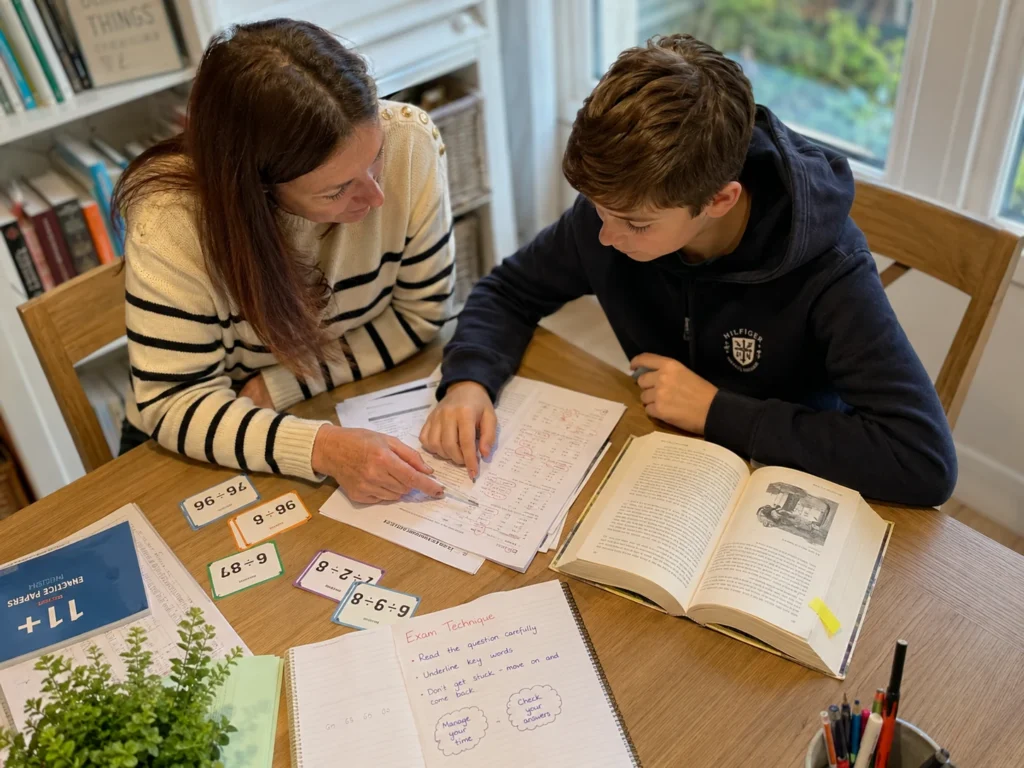
Year 4 — The Foundation Year
Year 4 should ideally feel light and enjoyable. Formal study at this stage is usually modest, perhaps one to two hours a week, but the real requirement is daily reading.
Children who read twenty minutes a day quietly build comprehension, vocabulary and sentence awareness without it feeling like revision. Alongside that, ten to fifteen minutes of mental maths three or four times a week helps hugely with numeracy.
A weekly reasoning puzzle, logic challenge or vocabulary activity is useful too. What Year 4 generally should not include is heavy past-paper work, as starting full papers too early is often off-putting.
Year 5 — Structured Preparation
Year 5 is where preparation becomes more focused. In the autumn term, two to three hours a week is usually enough for standard grammar or mainstream independent routes. The focus here is on building content; comprehension technique, arithmetic fluency, vocabulary and understanding reasoning.
By spring, three to four hours becomes more typical, as past-paper style questions begin to be tackled. By summer, four to six hours is often appropriate because timed practice and mocks start to be the focus.
For super-selective routes such as Tiffin Boys’ School admissions, the upper end of those ranges may be sensible, but even here, quality matters more than simply adding volume.
Year 6 — The Intensive Phase
Year 6 depends heavily on the exam date. For September-sitting routes, such as the Kent County Council Kent Test hours naturally rise through July and August. Around forty-five to sixty minutes most weekdays, plus one full mock paper each week, is often enough.
For January-sitting independent routes, including schools using the ISEB Common Pre-Test, the autumn term of Year 6 often becomes the most intensive phase, with six to ten hours weekly being realistic for many families. Even in Year 6, the strongest preparation still includes some rest.
The final fortnight before exams should usually be about sharpening and confidence-building, not cramming.
When You Are Doing Too Much
Knowing how much 11 Plus preparation is enough is something parents rarely hear honest advice on, as over-preparation can be quite common. Children can become mentally flat, lose interest in reading, start dreading study sessions, or show rising anxiety whenever timed work appears. Our piece on managing exam anxiety looks at these warning signs in more depth.
Young Minds has repeatedly highlighted how sustained academic pressure without balance can undermine confidence and well-being.
Parents should watch for warning signs such as growing irritability, reduced enthusiasm and upset before taking mock exams, as well as general fatigue.
If a child is doing ten or more hours a week at age ten and progress is stalling, the answer is often fewer hours with better review, not more hours piled on top.

Super-Selective Adjustment
There is a small caveat at the top end. Children targeting the most competitive routes will often need slightly higher hours, but only slightly. The difference is not usually double the work. It is sharper work, with more careful review of errors and higher quality mocks.
The Good Schools Guide frequently notes that children succeeding at the sharpest end are usually not simply “working more”. They are often working more intelligently and more steadily over time.
How Lionheart Education Calibrates Hours Per Child
No two children are the same. Some pupils genuinely need less than the standard schedule because they are already academically advanced and highly efficient learners. Others need more time because foundations are weaker or confidence needs building gradually.
Lionheart Education starts with a free baseline mock, assesses reading age, arithmetic fluency and timed-pressure response, then builds a target-school-specific preparation plan. Children who benefit from structured group practice can also join our 11 Plus revision courses.
That plan is reviewed roughly every six weeks and adjusted honestly.
Sometimes that means increasing intensity, but quite often, it means telling families to reduce hours because the child is already doing too much.
FAQ’S
-
How many hours should my child study for the 11 Plus?
Year 4: 1–2 hours a week. Year 5: 2–6 hours a week, rising through the year. Year 6: 4–8 hours a week for September sittings; 6–10 hours a week in the autumn term for January sittings. More than 10 hours a week at this age is typically counterproductive. Reading daily (20+ minutes) underpins all preparation.
-
How long should each 11 Plus study session be?
For Year 4 and Year 5 autumn: 20–40 minute focused sessions. For Year 5 summer and Year 6: 45–60 minute sessions for timed past papers, with breaks between. Full mock papers (90 minutes for some tests) should be sat in one sitting under exam conditions, but not more than once a week.
-
Is it possible to over-prepare for the 11 Plus?
Yes, and it is common. Over-prepared children often show reading fatigue, exam-day anxiety or an actual drop in performance compared to their practice. The better lever is review quality (why was that wrong?) rather than raw hours. If a child is doing 10+ hours a week at age 10 and not improving, reduce hours rather than add them.
-
How many hours per day should a Year 6 do before the 11 Plus?
For a September-sitting school, aim for 45–60 minutes a day on weekdays in July and August, with a full mock paper once a week. For a January sitting, 45–60 minutes a day through the autumn term with a weekly mock. In the final two weeks, scale back to maintain freshness; last-minute cramming rarely helps.