How to tell if 11 Plus tutoring is working usually comes down to reading the signals that arrive before a mock exam score confirms them. Children begin to think differently before they begin scoring dramatically differently. They explain methods more clearly, approach difficult questions with greater composure, stop repeating the same mistakes, and gradually become more confident in areas that previously caused frustration. The clearest evidence often lies in those quieter shifts in behaviour and understanding, supported by hard measures such as improving timing, better error patterns, and a steady upward trend over six weeks rather than dramatic week-to-week jumps.
Why Parents Need Earlier Signals Than Mock Scores
One of the most difficult parts of paying for tutoring is uncertainty. Parents are often left asking whether genuine progress is being made or if they are funding extra work that feels productive but does not truly move the needle. Children may appear busy, homework may be getting done, and sessions may be happening regularly, yet beneath that surface activity lies a perfectly reasonable question: is this actually working?
The mistake many families make is waiting for the next mock exam to answer that question. By the time a disappointing mock score arrives, valuable months may already have passed. If progress has stalled, if the tutor is the wrong fit, or if the format is not right for the child, that lost time can be difficult to recover.
The better approach is to understand what progress looks like earlier, because real improvement almost always shows itself in subtle but reliable ways before headline scores catch up. How to choose a good 11 Plus tutor provides useful further reference on what strong tutoring should look like from the start.
Why Waiting for the Mock Is Often Too Late
Mock exams matter, but they are what educators would call a lagging indicator. They confirm where a child is after weeks or months of work, rather than showing clearly what is changing in the present. In most 11 Plus journeys, formal mocks arrive two or three months before the real examination, which means that by the time a mock reveals a problem, there is often much less room to correct it comfortably.
The families who manage tutoring most effectively tend not to wait passively for a score. Instead, they watch for smaller but more meaningful signs of movement. They notice whether their child now tackles unfamiliar questions with more calmness, whether explanations sound clearer and more confident, and whether mistakes are evolving rather than endlessly repeating. Those signals usually tell a truer story than a single paper completed on a difficult afternoon.
Five Signs Tutoring Is Working
| Signal | What parents may notice | Why it matters |
|---|---|---|
| Clearer explanations | The child explains the method, not just answers | Shows process ownership |
| Better response to difficulty | The child pauses and tries rather than panics | Shows growing composure |
| Changing mistake patterns | Old errors are reduced, and new errors are more specific | Shows learning is moving |
| Gradual timing improvement | Questions take less time without rushing | Shows fluency is developing |
| More precise language | The child names question types and methods | Shows understanding is becoming structured |
| Better homework independence | The child starts or completes work with less resistance | Shows confidence and routine are improving |
| More specific tutor feedback | Parents know what is being targeted next | Shows the tutoring has direction |
| Six-week trend improvement | Scores, accuracy or method improve over time | Shows progress is real, not accidental |
Signal 1: Your Child Explains Thinking, Not Just Answers
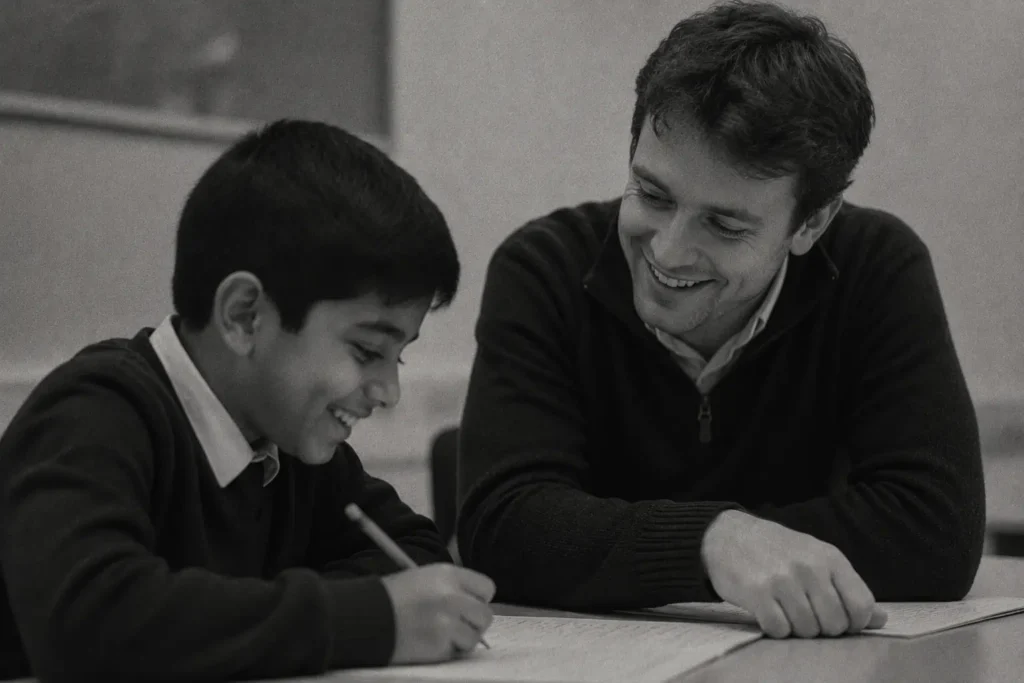
One of the clearest indications that tutoring is working is when a child begins to explain how they arrived at an answer rather than simply telling you whether it was right or wrong. That may sound small, but it reflects a major change in learning.
A child who says, “I got it right,” may have recognised a familiar question. A child who says, “I spotted that this was a ratio question, simplified first, then worked backwards from the total,” is showing something much more valuable: method ownership.
This is often where strong tutoring first becomes visible. The child’s language becomes more precise, their explanations become more organised, and they start sounding like someone who understands what they are doing rather than someone hoping they happen to be right.
Why experience matters in 11 Plus tutoring may be useful here because experienced tutors are often quicker at building this kind of method ownership.
Signal 2: Confidence Appears in How Children Face Harder Work
Another reliable signal is what happens when a child meets difficulty. Children who are making genuine progress still find hard questions challenging, but they react to that challenge differently. Instead of freezing, guessing wildly or immediately asking for help, they pause and think. They begin somewhere sensible, test an approach and stay with the problem for longer.
That growing resilience matters because selective exams are not designed to feel easy. Children will meet unfamiliar wording, awkwardly framed questions and moments of uncertainty. Progress is often best measured by how calmly they now handle that uncertainty. Confidence, in this context, is not swagger or overconfidence. It is quiet control.
Signal 3: Mistakes Change Shape
Parents naturally focus on how many mistakes are being made, but what matters as much is which mistakes are being made. If a child continues to make the same conceptual errors six weeks later, that is worrying. If, however, those original misunderstandings have largely disappeared and the remaining mistakes are now mostly timing slips, occasional carelessness or pressure-related errors, that usually means understanding has improved significantly.
In other words, mistakes that change shape are often evidence that learning is moving forward. A child who once struggled to understand fractions but now understands them clearly, only occasionally making arithmetic slips under time pressure, is in a far stronger place, even if the raw score has not yet jumped dramatically.
The Education Endowment Foundation one-to-one tuition evidence highlights the value of focused support, and this is exactly where tutoring should show itself: in clearer understanding and fewer repeated errors.
Signal 4: Timing Improves Gradually
Parents often expect speed gains to appear suddenly, but timing improvements usually emerge quietly and steadily. Questions that once took 90 seconds now take 60. Methods that once required prompting become automatic. Children stop wasting time deciding where to begin because they recognise what kind of question they are facing much more quickly.
That fluency is a major indicator that tutoring is working, as it shows that thinking is becoming more efficient. The Sutton Trust has highlighted the impact structured tutoring can have on attainment, particularly when progress is measured carefully rather than assumed.
Why timing is the biggest challenge in the 11 Plus may help families determine whether the issue is with teaching, pace, or exam execution.
Signal 5: Progress Has a Rhythm
Parents are often surprised by how long meaningful progress can take to become obvious. The first two weeks of tutoring frequently show little outward change because strong tutors are diagnosing, building rapport and identifying underlying weaknesses rather than chasing quick wins.
By weeks three and four, children often begin sounding more secure. They approach work with more confidence and explain ideas more clearly. By weeks five to eight, score trends usually begin reflecting that deeper shift. Later still, progress may briefly plateau while timing, stamina, and exam composure are refined. Plateaus are normal. Stagnation without a plan is not.
Why some children plateau in 11 Plus preparation provides useful further reference if progress has slowed, but the underlying signals still look positive.
Red Flags Parents Should Not Ignore
When tutoring is not working, warning signs tend to repeat themselves. A child may keep repeating the same mistakes, session after session. Homework may become a battleground. Confidence may slowly shrink rather than grow. Parents may receive vague reassurance but little specific explanation of what is improving or what is being targeted next.
A strong tutor should be able to explain clearly where your child is now, what has improved, what remains weak and what the next four weeks are designed to address. If that clarity is missing, concern is reasonable.
Red Flags and Possible Responses
| Red flag | What it may mean | Sensible response |
|---|---|---|
| Same mistakes after six weeks | Weak diagnosis or poor review | Ask for an error-pattern plan |
| Vague tutor feedback | No clear teaching direction | Request written progress notes |
| Falling confidence | Poor fit or too much pressure | Review tutor style and workload |
| Homework battles | Overload, poor routine or wrong format | Adjust volume and structure |
| No timing improvement | Method not becoming fluent | Add paced drills |
| No plan after a bad mock | Reactive tutoring | Ask for a four-week recovery plan |
Sometimes the Problem Is Not the Tutor
A lack of visible progress does not always indicate poor tutoring. Sometimes the format is wrong. A child may need the motivation of a small group rather than the intensity of one-to-one, or they may need individual attention rather than broad class exposure.
Sometimes the issue is consistency outside of lessons. Homework is incomplete, school pressure is high, sleep is poor, or home is stressful. A child may be mentally overloaded. Sometimes, of course, the tutor is not the right fit.
The important thing is to diagnose honestly rather than to drift on. One-to-one tutoring vs group tutoring for the 11 Plus may help families decide whether the current format is properly supporting the child.

What Good Tutoring Looks Like From a Parent’s Perspective
Good tutoring should feel purposeful. Parents should understand what is being worked on and why. The child should gradually sound more confident and more methodical. Mistakes should evolve, timing should improve, and confidence should become steadier.
Most importantly, there should be a clear sense that the child is learning how to think better, not simply being given more work. That is what real progress looks like.
How Lionheart Education Tracks Whether Tutoring Is Working
Lionheart Education measures progress carefully from the outset, using a baseline diagnostic, ongoing error-pattern tracking, written parent updates and clear topic mapping so families understand exactly where improvement is happening and where work still needs to be done. If signals are not moving in the right direction, the approach is adjusted quickly rather than waiting passively for disappointing mock results.
That willingness to measure honestly is what turns tutoring from hopeful spending into a purposeful investment.
For families seeking structured support, 11 Plus tuition explains how Lionheart Education builds tutoring around diagnosis, progress tracking and the child’s target exam route.
FAQs
-
How long before tutoring should show results?
Most children begin showing stronger method confidence within three to four weeks, with measurable score improvement often appearing between weeks five and eight.
-
My child’s scores have not moved. Should I worry?
Not necessarily. If mistakes are changing, confidence is growing, and methods are clearer, scores often lag behind greater improvement by a few weeks.
-
Should I ask for written progress reports?
Yes. Clear written updates are extremely helpful because they force specificity and give parents a clearer view of what is being targeted.
-
Is it ever right to change a tutor?
Yes. If progress is flat, confidence is falling, and there is no credible plan for change, switching may be wise.
-
What matters most when judging tutoring?
Look for the trend over six weeks, not isolated good or bad days. Method, confidence, timing, and mistake patterns are often more revealing than a single mock score.