11 Plus exam technique rests on five habits: reading the question before solving, managing time by section, using a sensible bail-out rule, checking key steps rather than reworking whole answers, and classifying mistakes after each paper. Adaptive tests such as the ISEB Common Pre-Test are different because questions cannot usually be revisited, so steady pacing and composure matter more than strategic skipping.
Why Exam Technique Matters
Many children reach a point in their preparation when they understand the content but do not perform as expected on tests. They can solve problems correctly during practice, explain their thinking clearly and work through questions methodically. Still, when exam conditions are introduced, accuracy drops, timing becomes difficult, and results fall below what parents know their child can do.
That gap is very often not a knowledge gap. It is an exam technique gap.
Exam technique determines how effectively a child applies what they know under pressure. It shapes how they read questions, pace themselves, decide when to move on and recover after a difficult section. Improving this area frequently yields noticeable gains without requiring relearning large amounts of content.
Families comparing paper formats may find How 11 Plus papers are really designed useful here, because exam technique needs to match the assessment being sat.
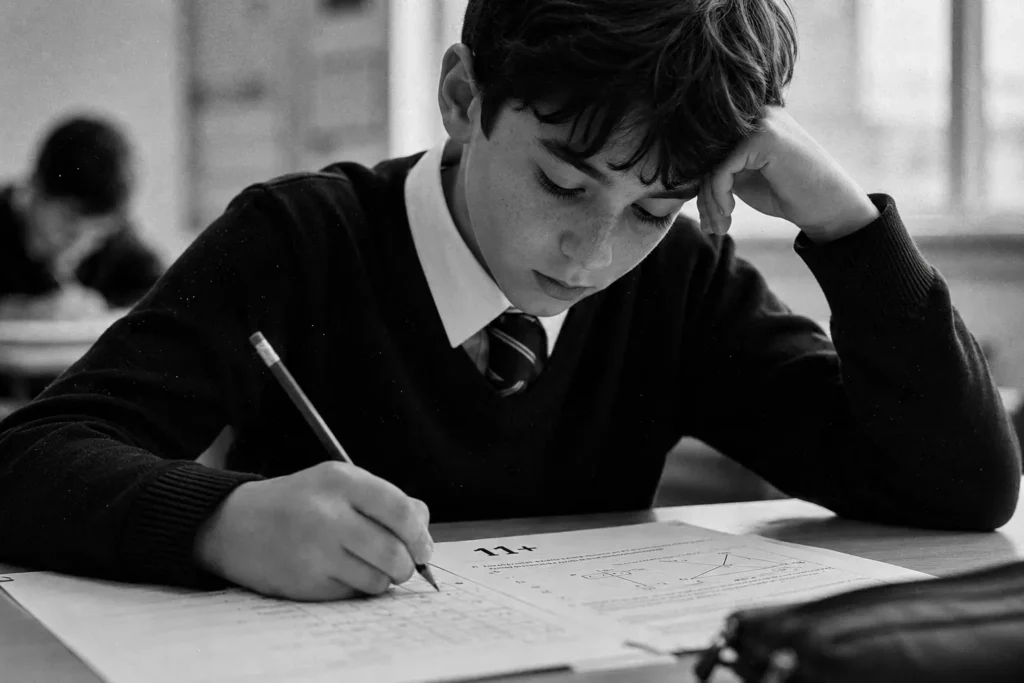
What Exam Technique Means In The 11 Plus
Good exam technique is a set of habits. These habits can be taught, practised and improved over time.
| Habit | Target stage | Drill type | Exam benefit |
| Read the question before solving. | Weeks 1–8 | Highlight key words | Fewer misreads |
| Manage time by section. | Weeks 8+ | Timed section drills | Fewer overruns |
| Use a bail-out rule. | Weeks 8+ | Skip-and-return practice | Better paper coverage |
| Check key steps | Weeks 4+ | Final-answer check habit | Fewer careless errors |
| Classify mistakes | Every paper | Same-day review | Targeted improvement |
| Build composure | Final 4 weeks | Mock routines | More stable performance |
The first habit is simple but powerful: read the question carefully before doing anything else. Many marks disappear because children rush into solving before properly understanding what is being asked.
The second habit is section-level timing. Children perform better when they think about how they are doing across a section rather than obsessing over every individual question.
The third habit is the bail-out rule. For many reasoning questions, if meaningful progress has not been made after 45–60 seconds, it is sensible to move on to longer maths word problems, which may stretch closer to 90 seconds.
The fourth habit is checking key steps, not whole answers. A quick check to see whether the child answered correctly, used the correct unit, and produced a sensible answer is often enough to catch avoidable mistakes.
The fifth habit is classifying errors after every paper. The Learning Scientists have repeatedly highlighted the value of retrieval and deliberate review in strengthening learning, and mistake review works in the same way in exam technique.
Managing Time Effectively
Time management is one of the most visible aspects of technique. For many GL-style papers, broad timing benchmarks can be useful, although exact timings vary by area and school.
| Area | Typical timing pressure | Technique priority |
| Verbal reasoning | Often very fast, sometimes around 30–40 seconds per question | Recognition and bail-out discipline |
| Maths | Often around one minute per question, depending on format | Accurate setup and moving on when stuck |
| English comprehension | Timing varies by passage length and question style | Evidence location and precise answering |
| Non-verbal reasoning | Often fast, with some harder visual items | Pattern recognition and educated guessing |
GL Assessment style papers reward pace and accuracy together. Children often run out of time, not because they are slow overall, but because they spend too long wrestling with difficult questions.
This is where the bail-out rule matters. Move on, keep the paper moving and return later if possible.
Adaptive tests are different. In the ISEB Common Pre-Test, questions appear one at a time and cannot usually be revisited. Strategic skipping is therefore not possible in the same way. Technique becomes about a steady rhythm, calm decision-making and maintaining control rather than tactical movement around a paper.
That is a very different skill. How long 11 Plus preparation takes may help families understand when timed work should become a larger part of preparation.
Balancing Speed And Accuracy
Parents often ask whether they should focus on speed or accuracy first. The answer is accuracy first, then speed.
The method creates speed. When children recognise patterns quickly and know how to approach familiar question families, pace improves naturally without rushing.
Rushing creates careless errors: misreading, skipped words, arithmetic slips, selecting the wrong option line or answering what the child thought was asked rather than what was actually asked. These are different from concept errors, where a child genuinely does not know how to solve something.
That distinction matters because each error type needs a different fix.
Error Classification
| Error type | Meaning | Best fix |
| Concept error | The child did not know the method | Teach or reteach the method |
| Process error | The child used a weak approach | Improve the solving strategy |
| Careless error | The child knew it, but slipped | Slow down and add checking habits |
| Timing error | The child ran out of time | Use bail-out drills and section timing |
| Composure error | Child panicked or froze | Use mock conditioning and calm routines |
The Education Endowment Foundation Teaching and Learning Toolkit consistently reinforces that deliberate practice with targeted feedback produces stronger gains than repeated unguided repetition. In exam technique, that means each mistake should teach the child something specific.
Practising Under Exam Conditions
Timed practice should be structured. A strong routine in the final preparation phase might include one paper per week, completed in a quiet room with no interruptions and strict timing. The paper should then be marked on the same day, with wrong questions reattempted before answers are reviewed. Mistakes should be classified and added to a weekly mistake log.
That turns each paper into a learning experience rather than merely a test.
Useful practice materials from Resources from Bond 11+, CGP, the National Literacy Trust, and BBC Bitesize KS2 can all support preparation, but they work best when used within a structured routine.
How to use 11 Plus practice papers properly provides further reference for families moving into the timed-paper stage.
Improving Performance Under Pressure
Pressure changes behaviour. Children often know exactly how to solve a question, but under time pressure, they hesitate, rush or overthink.
Composure is trainable. Useful routines include one minute of controlled breathing before a paper, a calm first-minute scan of the paper structure where appropriate, deliberate practice of the bail-out rule, avoiding post-paper panic discussions with peers and sitting occasional mocks in unfamiliar environments.
GOV.UK grammar school guidance gives the broader context for selective grammar routes, many of which are highly competitive. The Good Schools Guide often reflects a truth families discover during preparation: composure matters as much as raw ability once children reach a high level.

Technique Differences By Exam Route
The exam technique should match the paper. A child preparing for a fixed-format multiple-choice test needs different habits from a child preparing for an adaptive online assessment or a written independent-school paper.
Gl-Style Papers
In GL-style papers, children need quick recognition, efficient elimination, careful transfer of answers, and strong bail-out discipline. They should avoid getting trapped by one difficult question at the expense of several easier ones later.
Iseb-Style Adaptive Tests
In the ISEB Common Pre-Test, children usually cannot return to earlier questions, so the focus is on steady pacing, calm decision-making and avoiding panic after a difficult item. The child must move forward confidently.
Written Independent-School Papers
In written papers, techniques include showing working, structuring written answers, using evidence and keeping handwriting legible under time pressure. For families preparing for this route, “How to prepare for 11 Plus and independent school assessments” provides a broader context.
How Lionheart Education Improves Exam Technique
Exam technique improves when children are taught how to perform under exam conditions, not simply given more questions to complete. Lionheart Education focuses directly on timing, pacing, error recognition and composure across fixed-format grammar-school papers, school-set independent assessments and adaptive tests such as the ISEB Common Pre-Test.
That allows improvements in practice to transfer more reliably into performance on the day that matters. For families seeking structured support, 11 Plus tuition explains how exam technique can be built alongside English, Maths, verbal reasoning and non-verbal reasoning.
FAQ’S
-
What is the exam technique in the 11 Plus?
Exam technique refers to the habits that help a child perform under pressure, including reading the question carefully, managing time, moving on when stuck, checking key steps, and reviewing mistakes properly afterwards.
-
Do children need different techniques for adaptive tests like the ISEB Common Pre-Test?
Yes. Because questions cannot usually be revisited, steady pacing and composure matter more than tactical skipping. Children need to make a careful decision, answer and move forward calmly.
-
How can my child improve timing in exams?
Use section-level timing, introduce bail-out drills and practise regular timed papers under realistic conditions. Timing improves fastest when accuracy and method are already secure.
-
Why does my child make mistakes under pressure?
Pressure often leads to careless errors rather than conceptual errors. Composure drills, realistic mocks and structured timed practice usually help more than extra content work.
-
How important is exam technique compared with knowledge?
Both matter. Knowledge sets the ceiling, but technique determines how much of that knowledge a child actually delivers in the exam.