Advanced cube-folding techniques rely on three principles beyond the basic fold: opposite faces never touch, symbol orientation rotates with the face as it folds, and the reject-first method eliminates impossible answers before confirming the correct one. Once children master those ideas, cube-folding questions become quicker, calmer and more accurate, with many strong candidates reducing their solving time to under a minute per question.
Why Advanced Cube Folding Matters
For many pupils, cube folding begins as a slow mental construction exercise in which they attempt to build the entire cube in their head. That works at beginner level, but it becomes too time-consuming for competitive 11 Plus papers, particularly in GL-style non-verbal reasoning sections where pace matters almost as much as correctness.
GL Assessment remains one of the main testing routes where non-verbal reasoning skills can be important. In these papers, stronger pupils do not usually fully build the cube every time. Instead, they apply elimination principles to reject impossible options quickly, then confirm the surviving answer with careful orientation checking.
Basic cube folding is useful because it teaches spatial understanding, but advanced cube folding is what turns that understanding into exam performance. A child using a full mental build approach may take between 60 and 90 seconds to solve a difficult cube question. That is acceptable in early learning, but expensive in exam time. Across a paper, those extra seconds quickly become several lost minutes.
How to improve non-verbal reasoning for the 11 Plus provides a useful wider context on how cube folding fits into the broader NVR skill set.
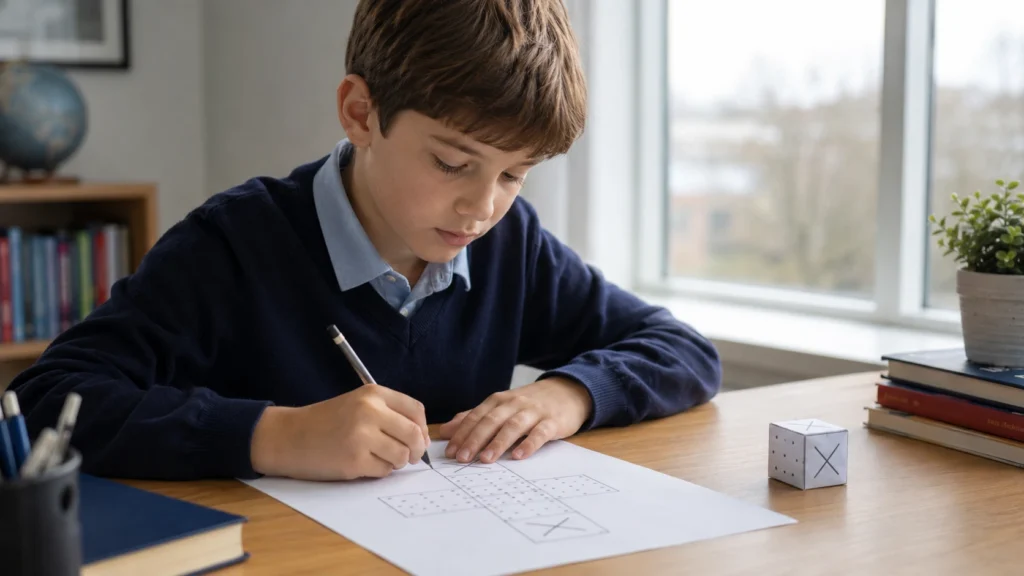
Basic vs Advanced Cube Folding Technique
| Technique | Typical time per question | Accuracy |
| Basic fold: build the whole cube mentally | 60–90 seconds | High once secure |
| Advanced reject-first approach | 40–50 seconds | High once practised |
| Combined situational approach | 45–60 seconds | Often the strongest overall |
For stronger candidates, that time saving is significant. Across a full non-verbal reasoning paper, it can create two to three extra minutes for harder questions elsewhere.
Advanced Principle 1: Opposite Faces Never Touch
This is the most powerful shortcut in cube folding. On a cube, opposite faces can never share an edge. If two faces are opposite, they will never appear touching one another in any valid folded cube.
That means if an answer option shows two opposite faces sitting side by side, it is impossible and can be rejected instantly. This single rule eliminates a remarkable number of wrong answers before any complicated folding begins.
Children who understand opposite faces well often solve half the puzzle before they even start mentally folding. The NRICH spatial reasoning resources reinforce this kind of structured visual thinking, where strong spatial problem-solvers look first for impossible arrangements before attempting full construction.
Advanced Principle 2: Symbol Orientation
Symbol orientation is where advanced questions separate good candidates from very strong ones. A face may be correct, but the symbol on that face may be rotated incorrectly.
Imagine a dot drawn in the top-left corner of a square face on the flat net. Once folded, that same dot may end up in the top-right, bottom-left, or bottom-right, depending on how the face rotates into position. The face is still the same, but the symbol has moved because the orientation has changed.
That is why children must track not just which face folds where, but how that face turns during folding. Many difficult cube questions are designed so that several answer options contain the correct faces, yet only one contains the correct symbol orientation.
That is the real discriminator.
Advanced Principle 3: The Reject-first Approach
The fastest advanced cube folders rarely start by providing the right answer. They start by disproving wrong answers.
This is the reject-first method. Children look at each answer option and ask whether it shows impossible adjacency, places opposite faces together, uses symbol orientation that cannot work, or contradicts the net.
If the answer is yes, the option can be eliminated immediately. Usually, two or three answers disappear quickly, and only then should the child carefully confirm the final surviving option.
That is much faster than mentally folding every answer from scratch. It is also calmer, because elimination reduces cognitive load.
Timing Drills for Advanced Cube Folding
Advanced cube folding should be trained progressively. Speed should grow from confidence, not from rushing.
| Stage | Focus | Target |
| Weeks 1–2 | Basic folding, untimed | Understand how nets form cubes |
| Weeks 3–4 | Opposite-faces rule | Move towards under 60 seconds |
| Weeks 5–6 | Symbol orientation tracking | Move towards under 50 seconds |
| Week 7 onwards | Reject-first elimination | Aim for 40–50 seconds, where realistic |
This steady progression works because each layer builds on the previous one.
For practice, strong national resources include Bond 11+ and CGP. These provide useful exposure, but technique, especially reject-first and orientation tracking, is what transforms performance.
Common Advanced Cube-folding Errors
Identifying the Correct Faces but Ignoring Rotation
This is one of the most common advanced errors. A child may correctly identify which faces should be visible, but choose an answer where the symbol has rotated into an impossible position.
Rotating the Whole Cube Inconsistently
Some pupils mentally turn the cube one way, then unconsciously switch viewpoint halfway through. This creates orientation confusion and leads to avoidable mistakes.
Misidentifying Opposite Faces
The reject-first method only works if opposite faces have been identified accurately. If a child wrongly classifies neighbouring faces as opposite, they may eliminate the correct answer.
Rushing Elimination
Elimination should be fast, but not careless. Careful checking remains quicker than hurried guessing.
How to Review Cube-folding Mistakes
A simple error log is extremely useful. When a child records whether they missed opposite-face logic, symbol orientation, adjacency or elimination logic, patterns emerge quickly.
If most errors come from opposite faces, a more basic network is needed. If errors come from orientation, physical cube work and slower rotation practice will help. If errors come from rushing, timed drills should pause until the method becomes more secure.
Common 11 Plus NVR types provides further reference for families comparing cube folding with other non-verbal reasoning question families.

How Lionheart Education Teaches Advanced Cube Folding
Lionheart Education teaches cube folding as a layered technique rather than a single visual puzzle type. Children first secure basic folding, then learn opposite-face recognition, symbol orientation tracking and finally reject-first elimination under timed conditions. Each principle is trained separately before being combined.
That structured progression creates genuine speed because pupils understand why an answer is right or wrong rather than relying on instinct alone. Our 11 Plus revision courses put these cube-folding drills into timed exam practice.
For families seeking wider support, 11 Plus tuition explains how Lionheart Education develops non-verbal reasoning alongside English, Maths, verbal reasoning and exam technique.
FAQ’S
-
How do you solve advanced cube-folding questions quickly?
Use three principles: opposite faces never touch, symbol orientation rotates with folding, and reject-first elimination removes impossible answers before confirming the correct one.
-
What is the reject-first method in cube folding?
The reject-first method means eliminating impossible answer options before trying to prove the correct answer. It reduces cognitive load and saves time.
-
How long should an advanced cube-folding question take?
Around forty to fifty seconds is a strong advanced target for secure pupils. Much beyond sixty seconds usually means the shortcuts are not yet automatic.
-
What is the hardest type of cube-folding question?
Questions where several answers show the correct faces but only one shows the correct symbol rotation are usually the most difficult.
-
Can cube folding be improved?
Yes. Cube folding improves significantly when children move from slow whole-cube construction to structured techniques such as opposite-face recognition, orientation tracking and reject-first elimination.