The most common mistakes in 11 Plus maths are times-tables hesitancy, misreading word problems, fraction-decimal-percentage confusion, unit errors, column-addition carrying mistakes, negative-number sign errors, rushing simple questions, missing multi-step layers, not checking answers and running out of time. Each has a specific fix, and most repeated patterns can improve quickly when practice is short, targeted, and properly reviewed.
Why Mistakes In 11 Plus Maths Cost More Than Children Realise
One dropped mark in a selective-school maths paper is rarely “just one mark”. In a tightly timed paper, every mark counts, and losing five marks through avoidable errors can materially affect ranking, particularly on competitive grammar-school routes from Buckinghamshire and Birmingham to Trafford, Warwickshire, Essex selective consortia, and demanding independent-school entry.
That is what makes avoidable maths errors so frustrating. Most are not caused by weak maths. Repeated habits cause them, and repeated habits can be fixed.
GL Assessment papers reward fluency and precision under pressure, while the ISEB Common Pre-Test also rewards quick, accurate numerical reasoning in its adaptive format. In both cases, the strongest pupils are rarely mistake-free because they are naturally gifted. They are usually mistake-free because they have been trained on specific weak spots until those habits improve.
Families wanting a broader explanation of how different exams reward accuracy and timing may also find How 11 Plus papers are designed useful.

Ten Common Mistakes In 11 Plus Maths And The Targeted Fix
| Mistake | Signal | Targeted fix |
| Times-tables hesitancy | Pauses on facts such as 7 × 8, 8 × 6 or 9 × 7 | Daily five-minute recall drill |
| Misreading word problems | Correct calculation, wrong question answered | Underline key information and re-read the final ask |
| Fraction / decimal / percentage confusion | Cannot switch confidently between equivalent forms | Side-by-side conversion practice |
| Unit errors | Right maths, wrong unit | Write the unit every time and check whether it makes sense |
| Column-addition carrying errors | Answer is out by 10, 100 or 1,000 | Align digits and mark carries clearly |
| Negative-number sign errors | Sign errors in addition or subtraction | Use number-line movement before abstract rules |
| Rushing easy questions | Marks dropped in the first few questions | Slow the first five questions deliberately |
| Missing multi-step layers | Stops after the first calculation | Underline the final sentence before solving |
| Not checking answers | Catchable mistakes remain | Mark uncertain questions and leave review time |
| Running out of time | Later questions left blank | Guess sensibly, move on and return if time remains |
Lionheart Education uses this mistake-categorisation framework because it helps families identify quickly where marks are leaking.
Times-Tables Hesitancy
Times-tables hesitancy is one of the hidden killers in 11 Plus maths. A child who pauses on facts such as 7 × 8, 8 × 6 or 9 × 7 may only lose two or three seconds at a time, but those pauses quietly drain minutes across a full paper.
The bigger issue is cognitive load. If a child is still working out basic multiplication facts, less mental space is available for the actual problem. By the end of Year 4, times tables to 12 × 12 should be known instantly rather than mostly memorised.
Topmarks Hit the Button is excellent for building automaticity quickly, and BBC Bitesize KS2 Maths also provides useful fluency practice. Five minutes a day for three or four weeks often closes obvious gaps.
This is one of the fastest wins available.
Misreading Word Problems
Many bright children can do the maths but answer the wrong question. This happens constantly in 11 Plus work because pupils see numbers, rush into an operation and forget to check what the question is actually asking.
For example, if a question says a train travels 120 miles in 2 hours and asks for its average speed, a rushed child may calculate 120 × 2 because those are the numbers on the page. The correct approach is to identify that speed is being asked for, then divide the distance by the time.
The fix is mechanical. Children should read once, underline key numbers, underline the final question, solve, and then ask whether the answer actually answers the question. That one habit saves marks repeatedly.
Parents who want a broader strategy for using papers effectively may find How to use 11 Plus practice papers properly useful.
Fraction, Decimal, and Percentage Confusion
Children often know simple equivalences, such as ½ = 0.5 = 50%, but hesitate with less familiar forms, such as ⅜, 0.375, and 37.5%. That lack of interchangeability costs marks in mixed-format questions.
The fix is side-by-side practice. Children should write the fraction, decimal, and percentage equivalents together, then convert in both directions repeatedly. Number-line visualisation also helps because children begin to see equivalence rather than memorising disconnected facts.
NRICH has strong conceptual maths resources that can help children understand these relationships more deeply. Understanding beats recall here.
Unit Errors
Unit errors are painful because the calculation is often correct. A child may write 300 cm when the question asks for metres, or 4,500 g when the answer should be given in kilograms.
The fix is simple but powerful: always write the unit, and always ask whether it makes sense. This tiny pause catches many errors, especially in measurement, money, speed, area and volume questions.
For 11 Plus, unit accuracy is not a cosmetic detail. It is part of the answer.
Column-Addition Carrying Errors
Column addition and subtraction errors remain surprisingly common, even in bright pupils. Children forget carries, misalign columns, carry into the wrong place value or place decimal points inaccurately. The answer appears correct, but it is still incorrect.
The fix is neatness with purpose. Children should line up digits vertically, mark carries clearly above the relevant columns, and double-check place-value alignment before moving on.
Neatness is not cosmetic in maths. It is accuracy.
Negative-Number Sign Errors
Children commonly make errors such as -5 – 3 = -2 because they are processing signs mechanically rather than visually. Number lines are the clearest fix.
For younger pupils, movement is often easier than abstract rules. Move left for subtraction and right for addition. Once that understanding is secure, written sign rules become much less fragile.
Visual understanding sticks better than memorised rules, especially under timed pressure.
Rushing Easy Questions
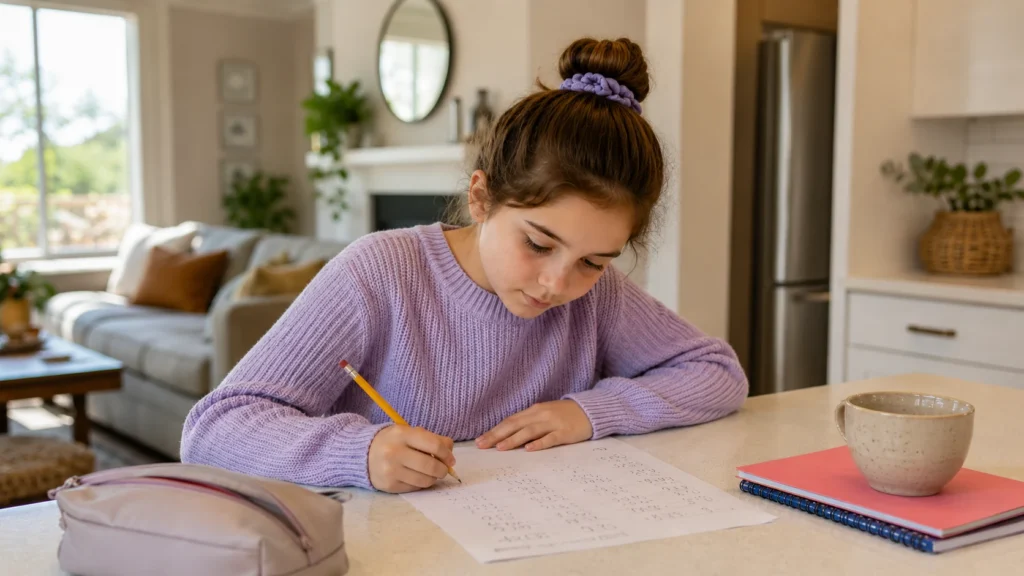
The first few questions often contain some of the easiest marks on the paper, yet many children drop one or two because they are rushing. That is damaging because easy marks count the same as hard marks.
The fix is to deliberately slow the first five questions. Children should settle, read carefully and build rhythm before accelerating. A calm opening often improves the paper as a whole by preventing early panic and careless slips.
Missing Multi-Step Layers
Some pupils solve the first stage of a problem correctly, then stop too soon. For example, if a box contains 24 pencils, there are five boxes and half are given away, a child may calculate 24 × 5 = 120 and write 120 as the final answer. The question has not finished, because half are then given away, so the correct answer is 60.
The fix is to underline the final sentence before solving. Children should ask what the question is ultimately asking for, not simply what calculation appears first.
This is especially important in worded problems, where the final step is often where the mark is won or lost.
Not Checking Answers
Many wrong answers are obviously wrong on second reading, but children often submit without checking. This is usually not laziness. It is often a poor exam habit or a lack of planned review time.
The Education Endowment Foundation Feedback Toolkit regularly reinforces that feedback and correction are powerful learning tools. That principle applies strongly to 11 Plus maths.
Children should mark uncertain questions with a small dot and leave time to return to them. Fresh eyes catch surprising mistakes, especially in unit conversions, multi-step problems and arithmetic slips.
Running Out Of Time
Blank questions cost maximum marks. A sensible guess at least gives a chance.
If a child is stuck beyond about a minute, the better strategy is usually to guess sensibly, move on and return later if time remains. Children who cling too long to one difficult question often lose easier marks later in the paper.
That is poor exam economics.
Timing strategy is one reason maths preparation should include realistic timed work rather than only topic practice. Why timing is the biggest challenge provides further reference for families seeing strong homework marks but weaker timed-paper scores.
A Simple Weekly Drill To Fix Repeated Mistakes
A short weekly repair routine can make a large difference. It does not need to dominate family life.
On Monday, spend 5 minutes on times-table speed recall. On Wednesday, redo one previously missed word problem and identify exactly why it went wrong. On Friday, complete ten mixed questions in ten minutes and review any mistakes immediately.
That is fifteen minutes a week of deliberate repair. Small, consistent, and properly reviewed practice is much more effective than occasional long sessions without diagnosis.
How Much Improvement Is Realistic?
A child who systematically works through these ten families of mistakes in 11 Plus maths can often gain around five to eight marks within four to six weeks, depending on the starting point and the consistency with which the repair work is done.
At selective-school margins, five marks can be transformative. It may be the difference between an offer, a waiting-list position or disappointment.
Specific diagnosis creates specific improvement.
How Lionheart Education Diagnoses Maths Mistakes
Lionheart Education does not simply report a score. Tutors categorise errors into reading mistakes, unit mistakes, calculation slips, multi-step omissions, timing issues and concept gaps. That tells families exactly where marks are being lost, and the weekly drill is then built around that profile.
Progress is reviewed regularly so that improvement becomes measurable rather than vague. For families needing wider support, 11 Plus tuition explains how targeted preparation can address maths, English and reasoning together without simply adding more work.

-
What are the commonest 11 Plus maths mistakes?
The most common mistakes are hesitation with times tables, misreading word problems, confusion with fractions and decimals, unit errors, carrying mistakes, sign errors, rushing easy questions, missing multi-step layers, failing to check work, and running out of time.
-
How can I improve my child’s 11 Plus maths score?
Start with the diagnosis. Categorise every wrong answer into a mistake family, then run short weekly drills targeting those repeated patterns. Most children improve noticeably within four to six weeks when practice is targeted and reviewed.
-
Why does my bright child make silly maths mistakes?
Bright children usually make these mistakes because of time pressure, weak exam habits, poor checking routines, or over-familiarity, which can cause carelessness. It is rarely a sign of weak maths ability.
-
How fast should times tables be for the 11 Plus?
Times tables to 12 × 12 should be instant by the end of Year 4. Any sustained hesitation costs time and increases mental load across the paper.