Many selective London prep schools use the 7+ entrance exam to select pupils for entry to Year 3. It is usually set in January of Year 2 and typically includes an English paper, a Mathematics paper, sometimes verbal or non-verbal reasoning, and an interview or observation session. Schools commonly associated with 7+ entry include Westminster Under School, St Paul’s Juniors, King’s College Junior School Wimbledon, Sussex House School, Dulwich College Junior School, Falkner House and Bute House Preparatory School.
For many London parents, 7+ is the first truly competitive school admissions process they encounter. At this age, children are only six or seven, which makes the whole idea of entrance testing feel surprisingly early. That said, the strongest schools are not looking for polished miniature academics. They are looking for bright, engaged children with secure early literacy, confident number sense, curiosity, listening skills and the beginnings of thoughtful written expression.
Understanding what schools are actually assessing makes preparation far less intimidating and much more constructive.
What the 7+ Exam Is
The 7+ is the principal entry point into Year 3 at many leading London prep schools. Unlike 11+, there is no common national test, no shared syllabus and no universal format. Each school writes and marks its own assessments, which means content, difficulty and interview style can vary significantly between schools.
Despite that variation, broad patterns do emerge. Most schools assess English and Mathematics. Many add reasoning. Most also include interviews or observations, because schools want to understand how children think, communicate, and interact, rather than relying solely on written papers.
Editorial guides such as The Good Schools Guide and the Tatler Schools Guide regularly note that fit matters enormously at this stage, because prep schools are choosing children they believe will thrive in their particular educational culture, not simply those who can score highly on one morning of testing.
Families considering the wider prep-school landscape may also find Best prep schools London useful when comparing 7+ routes with later 11+ and 13+ pathways.

7+ Format: What Children Usually Sit
English
English papers usually include comprehension and writing. Comprehension passages are age-appropriate, though questions can still be demanding because schools are looking for understanding, vocabulary awareness and thoughtful inference, not merely literal retrieval.
Writing tasks may ask children to complete a story, respond to a picture prompt or write creatively around a short scenario. At this level, imagination matters, though clarity, sentence control, punctuation and neat handwriting matter too.
Mathematics
Mathematics papers usually last around thirty to forty-five minutes. Questions often cover arithmetic fluency, number bonds, place value, simple fractions, shape, measurement and multi-step reasoning appropriate to Year 2 and beyond.
Top prep schools frequently include stretch questions designed to separate very able candidates, so mathematical thinking is often just as important as quick calculation.
Reasoning
Some schools include verbal reasoning, non-verbal reasoning or both. These sections test pattern recognition, logic, vocabulary relationships and flexible thinking. Because reasoning is unfamiliar to many families, it can be an area where structured preparation makes a meaningful difference.
Interview or Observation
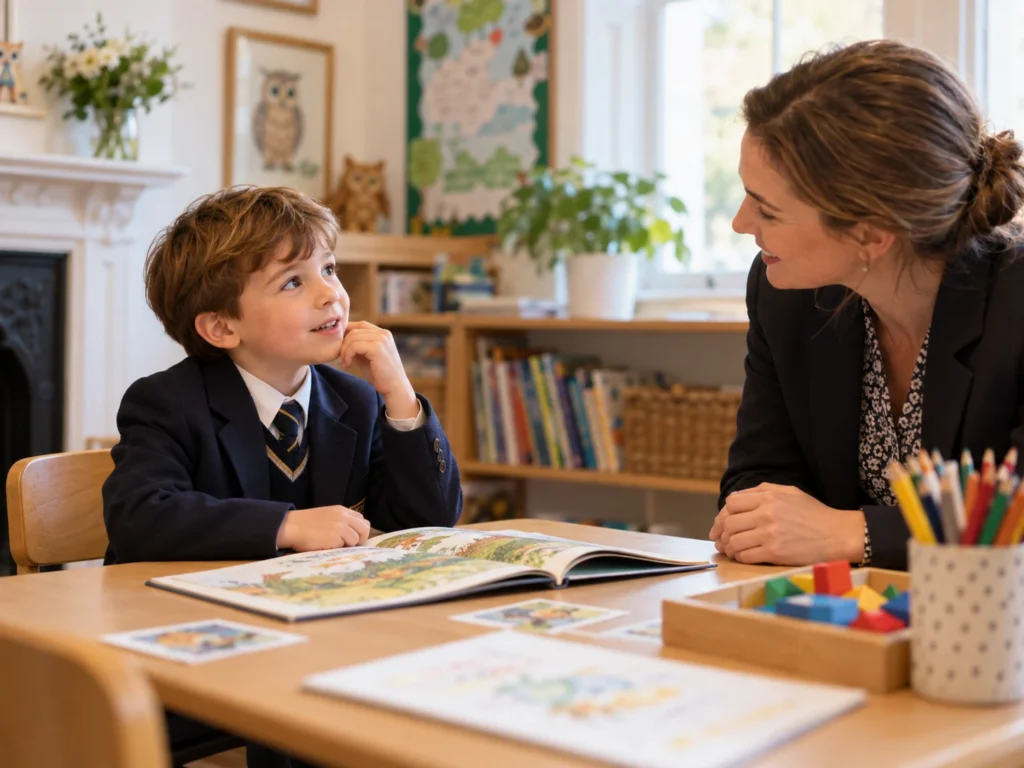
Interview format varies widely. Some schools hold one-to-one interviews. Others use paired or group observation. Teachers may chat about books, ask simple problem-solving questions or quietly observe social interaction during activities.
At this age, confidence, warmth and genuine engagement often matter more than polished answers.
Selected London Prep Schools Using 7+
Westminster Under School
Westminster Under School is one of the most academically competitive prep routes in London, and from 2026 it admits girls as well as boys at 7+. Its 7+ process is demanding, and success requires very strong English and Mathematics alongside maturity and interview confidence. It is also the main feeder into Westminster School, though pupils who join at 7+ still sit the standard entry testing for Year 9.
St Paul’s Juniors
St Paul’s Juniors has a highly respected 7+ route known for its academic rigour. English, Maths, reasoning and interview all matter, and competition remains consistently strong because it is closely connected to the wider St Paul’s School pathway.
Families considering this route may also find St Paul’s School admissions (TO: Internal blog) useful when thinking about how early prep entry connects to later senior-school progression.
King’s College Junior School Wimbledon
King’s College Junior School in Wimbledon is one of south-west London’s most sought-after boys’ prep schools, and girls will join the junior school for the first time from September 2029. It combines academic ambition with strong all-round development, and its 7+ process is widely respected for selecting bright, rounded pupils rather than simply narrow early crammers.
Sussex House School (8+)
Sussex House School has a particularly strong academic reputation and is often discussed as one of London’s most impressive boys’ prep pathways. Its main entry point is 8+ rather than 7+, with 36 places and an entry test each January covering English, Mathematics and verbal reasoning, alongside an interview. Its pupils have historically gone on to highly selective senior schools, including Eton College and Westminster School, making entry competition intense.
Dulwich College Junior School
Dulwich College Junior School remains one of south London’s strongest boys’ routes, combining academic challenge with broad co-curricular opportunity. Its 7+ entry is highly competitive, though often seen by families as a particularly strong long-term educational pathway because of continuity into the wider Dulwich structure.
Bute House Preparatory School for Girls
For girls, Bute House Preparatory School is among the names most frequently discussed by ambitious London families. Its 7+ involves a morning of assessment, followed by an interview for successful candidates. It is academically respected and offers strong onward pathways into highly regarded girls’ senior schools. Westminster Under School’s move to co-education also gives girls a new 7+ option from 2026.
Selected London Schools Using 7+ Entry
| School | Gender | Typical format | Notes |
|---|---|---|---|
| Westminster Under School | Co-ed (girls from 2026) | English, Maths and interview | Highly competitive Westminster route |
| St Paul’s Juniors | Boys | English, Maths, reasoning and interview | Strong route into St Paul’s School |
| King’s College Junior School | Boys (girls from 2029) | English, Maths and interview | Major Wimbledon pathway |
| Sussex House School | Boys | English, Maths, verbal reasoning and interview | 8+ entry; strong senior-school destinations |
| Dulwich College Junior School | Boys | English, Maths and reasoning | Broad all-round route |
| Bute House | Girls | English, Maths, observation and interview | Strong academic girls’ route |
How Competitive Is the 7+?
The honest answer is that at London’s most selective schools, competition is fierce. Westminster Under commonly attracts around 10 applicants per place. St Paul’s Juniors is often around six applicants per place, while King’s College Junior School may be around five applicants per place in many cycles.
These figures vary, though they illustrate the standard required. Schools are selecting from many bright children, so success usually depends on strong foundations rather than last-minute preparation.
This is why 7+ preparation should not be treated as a short, intense push just before the exam. Children need time to build reading stamina, writing confidence, mathematical fluency and emotional readiness. The strongest candidates usually look calm and capable because the habits behind their performance have been built gradually.
How to Prepare: A Year 1 and Year 2 Plan
Preparation should begin gently in Year 1. Reading widely, discussing books, strengthening vocabulary and building arithmetic fluency all create powerful foundations. Children should enjoy learning at this stage rather than feeling they are in a formal exam preparation phase.
At the start of Year 2, preparation can become more structured. Comprehension techniques, writing confidence, problem-solving in Maths, and gentle reasoning work all become useful. By the autumn of Year 2, many families introduce realistic mock papers to help children become comfortable with the timing and format.
By January, the strongest candidates are usually those who feel calm and familiar with the process, rather than those who are pushed intensely in a short burst.
Parents looking ahead to later selective routes may also find 11 Plus tuition useful as they consider how early preparation builds into longer-term academic confidence.
What Schools Look for in Creative Writing
Creative writing often becomes the differentiator because many bright children can perform strongly in Maths. Schools look for imagination, though they also value structure. A clear beginning, middle and end matters. Strong descriptive vocabulary helps. Varied sentence openings improve flow. Accurate punctuation matters because it signals control.
Most importantly, writing should sound like a bright child, not an over-coached adult. An authentic voice is often more persuasive than artificial sophistication.
A good 7+ story does not need complex literary technique. It needs a clear idea, lively vocabulary, controlled sentences and enough detail for the reader to feel that the child is thinking imaginatively and writing with care.
What Schools Look for in the Interview
The interview or observation stage is not designed to catch children out. Schools usually try to see whether a child can listen, respond, think aloud, and engage warmly with an unfamiliar adult or group.
A child may be asked about a favourite book, a picture, a simple puzzle or a classroom-style activity. Some schools may observe sharing, turn-taking or how the child responds when something is difficult.
Parents should avoid coaching set answers. A child who sounds rehearsed can appear less natural. The best preparation is usually conversation, reading, discussion, games that encourage reasoning and opportunities to speak confidently with adults in a relaxed way.
Families with younger children may also find Private nurseries London useful when thinking about how early-years confidence feeds into later prep-school readiness.
Common Mistakes Families Make
One common mistake is starting too late and then trying to compress too much pressure into the final term. This can make children anxious and reduce their natural confidence.
Another mistake is focusing only on papers. At 7+, schools assess the whole child, including maturity, listening, communication, and readiness for a selective prep-school environment.
Some families also over-coach writing, producing stories that sound adult but lack a natural childhood voice. Others neglect handwriting, punctuation or presentation, which can make otherwise strong work harder to reward.
Finally, parents should not assume all 7+ exams are the same. Westminster-style preparation, St Paul’s-style preparation, Dulwich-style preparation and girls’ prep-school preparation share foundations, but the details differ.
How Lionheart Education Prepares 7+ Candidates
Lionheart Education prepares children for 7+ using school-specific programmes carefully aligned with each target school’s format. Tutors build English comprehension, creative writing, mathematical reasoning and interview confidence in a way that feels encouraging rather than pressured, which is especially important at this age.
Mock assessments help children become comfortable with exam conditions. At the same time, tailored preparation ensures families understand that Westminster-style preparation, St Paul’s-style preparation, and girls’ prep-school preparation share a common foundation but differ in detail.
That school-specific understanding is often where preparation becomes most effective.
Parents considering focused support may also find 7 Plus tuition and Selective independent schools in London useful when planning the next stage of preparation.
FAQs
-
What Is the 7+ Entrance Exam?
The 7+ is an entrance assessment used by many selective London prep schools for Year 3 entry, usually involving English, Maths, and sometimes reasoning, and an interview or observation.
-
How Competitive Is the 7+?
It is extremely competitive at the most selective schools, with several applicants per place and strong assessment across both academic and personal readiness.
-
When Should We Start Preparing?
Foundational reading, vocabulary and arithmetic should develop naturally in Year 1, with more structured 7+ preparation usually beginning in Year 2.
-
What Is Tested in the 7+ Exam?
English, Mathematics, sometimes verbal or non-verbal reasoning, plus interview or observation, though the exact format varies by school.