The most selective private nurseries in London are often feeder settings into top preparatory schools, with strong reputations for placing children into highly sought-after 3+ and 4+ destinations. Names frequently discussed by London parents include Miss Daisy’s Nursery School in Hyde Park, Broadhurst School, Little Chepstow Nursery and Thomas’s Battersea Kindergarten, alongside Reception destinations such as Bute House Preparatory School and Pembridge Hall School. Full-time fees are typically around £12,000 to £20,000 or more per year, and in the most competitive settings, registration often occurs within weeks or months of birth.
For families new to London’s private early-years landscape, the nursery stage can come as a surprise because it is not simply childcare at this level. In many parts of west, south-west and north-west London, nursery choice is treated as the first strategic educational decision, particularly by families hoping eventually to secure places at highly selective preparatory schools.
That does not mean three-year-olds sit formal exams, though it does mean parents need to understand feeder patterns, registration timelines and the qualities prep schools tend to look for when children move on at 3+ or 4+.
What Makes a Feeder Nursery in London?
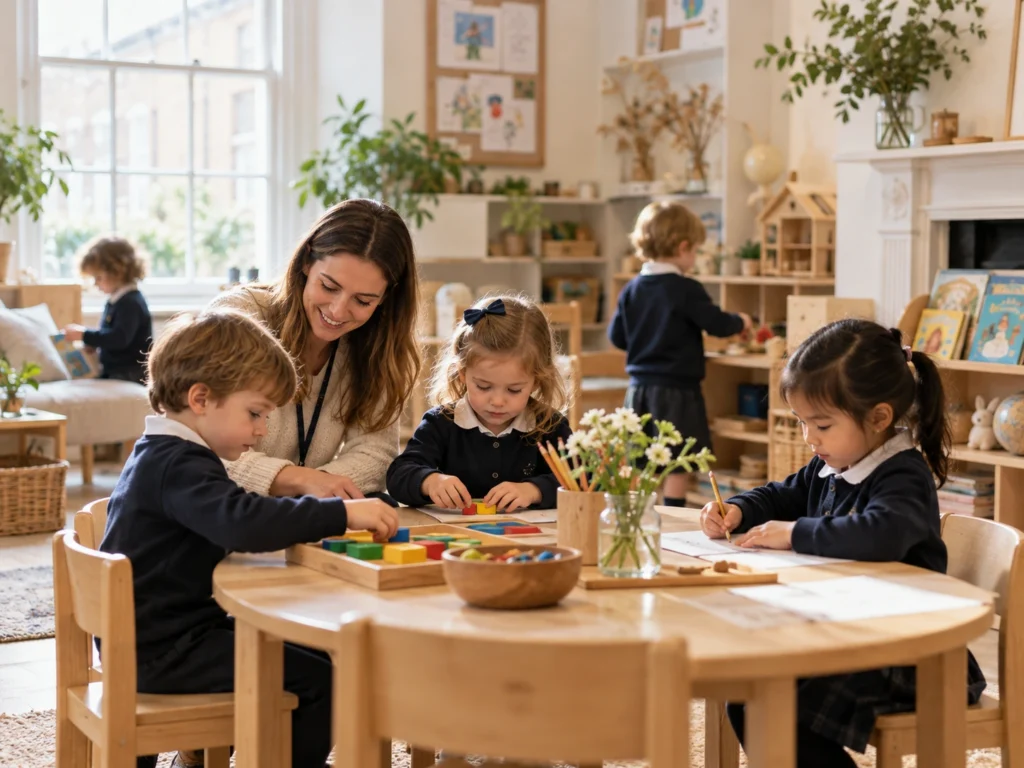
A feeder nursery is a setting with a strong, established track record of placing children in sought-after prep schools year after year. This usually reflects several things working together: experienced early-years staff, a carefully structured nursery curriculum, excellent communication with parents and a clear understanding of what leading pre-preps look for in very young children.
The strongest feeder nurseries are not artificially tutoring children. Instead, they build habits that matter at this age, such as confidence in separation from parents, social maturity, listening skills, language development, curiosity, fine motor control and the ability to engage happily and independently in structured play.
That foundation matters because London’s most competitive 3+ and 4+ pathways are looking for readiness rather than rehearsed performance.
Editorial guides such as The Good Schools Guide regularly highlight the importance of fit, because a nursery that feeds beautifully into one prep pathway may not be the best strategic choice for a different family’s goals.
Families thinking beyond nursery may also find Best prep schools London useful when considering how early-years choices connect to later prep-school destinations.
Selected London Nurseries and Reception Routes
Miss Daisy’s Nursery School, Hyde Park
Miss Daisy’s Nursery School in Hyde Park, W2, is one of central London’s best-known independent nursery settings. It has long been associated with strong onward placement into highly regarded prep schools and is often discussed by parents looking at prestigious West London pathways.
Its central location and longstanding reputation make it especially attractive to families in Notting Hill, Kensington, Bayswater and surrounding areas. For parents targeting leading west-London pre-preps, it often sits near the top of the early shortlist.
Broadhurst School
Broadhurst School in NW6 is a long-established South Hampstead favourite with deep roots in London’s independent-school ecosystem. It is respected for structured early-years development and for preparing children confidently for onward movement into strong preparatory settings.
Its reputation has been built steadily over decades rather than quickly through fashion, which is often a mark of enduring quality in London’s nursery market.
Bute House Preparatory School for Girls
Bute House Preparatory School for Girls in W6 does not have a nursery, but it is one of the most sought-after Reception destinations for girls in west London, with a strong academic reputation and a clearly defined onward pathway. Entry at 4+ is by ballot, drawn two years ahead of entry, and sisters of current pupils are offered places automatically. Nursery choice has no bearing on a Bute place at 4+, so registration timing matters far more than which nursery a girl attends.
Families seeking an academically ambitious girls’ education from the earliest years often shortlist Bute early, particularly because established routes into high-performing girls’ schools matter greatly in this part of London. For parents considering selective girls’ prep routes, the appeal lies in the continuity and confidence of a known school environment.
Pembridge Hall School
Pembridge Hall School in Notting Hill remains one of the most recognised girls’ prep schools in London. It has no nursery of its own. Reception is the main entry point and is non-selective, with places allocated by random selection designed to spread birthdays evenly across the year, which makes it a natural target for families planning ahead from the nursery stage.
Its reputation, location and educational consistency make demand very strong. Families considering Pembridge Hall should therefore register as soon after birth as possible and think about wider school-fit questions rather than treating nursery as a last-minute childcare decision.
Little Chepstow Nursery
Chepstow House School provides a co-educational early-years route through Little Chepstow Nursery, which is especially popular with West London families seeking strong academic foundations within a broad, modern prep-school environment. Its co-ed model appeals strongly to families seeking continuity for both sons and daughters within a single educational network.
Chepstow’s appeal is partly its balance: it offers the structure and ambition families expect from a respected prep-school pathway, while retaining a warmer and more contemporary feel than some more traditional routes.
Thomas’s Battersea Kindergarten
Thomas’s London Day Schools is one of London’s most recognised premium independent school groups. Its Battersea Kindergarten feeds into Thomas’s Battersea and a wider network of respected preparatory schools, and its brand reputation means competition for places is consistently strong.
For many London families, Thomas’s sits near the top of the shortlist from the moment nursery decisions begin. Its appeal lies in breadth, polish and the reassurance of an established school group with multiple prep pathways.
Kensington Early-Years Routes
Families looking in Kensington also frequently consider neighbouring premium independent early-years settings. This market is highly localised, which means postcode often shapes shortlists just as much as reputation.
For many parents, the most sensible nursery shortlist is therefore not simply “the best nurseries in London”, but the best nurseries within a realistic daily journey and aligned to the family’s likely prep-school goals.
Selected London Nurseries and Reception Routes at a Glance
| Setting | Location | Gender | Entry | Typical onward routes |
|---|---|---|---|---|
| Miss Daisy’s Nursery School, Hyde Park | W2 | Co-ed | Nursery | Leading west-London prep schools |
| Broadhurst School | NW6 | Co-ed | Nursery | Strong north-west London preps |
| Bute House Preparatory School for Girls | W6 | Girls | 4+ by ballot | Top London girls’ senior schools at 11+ |
| Pembridge Hall School | W2 | Girls | 4+ non-selective | Top girls’ senior schools at 11+ |
| Little Chepstow Nursery | W11 | Co-ed | Nursery | Chepstow House and wider prep routes |
| Thomas’s Battersea Kindergarten | SW11 | Co-ed | Nursery | Thomas’s prep pathways |
3+ and 4+ Entry into London Prep Schools
The idea of 3+ entry can sound intimidating, though in practice, the assessment process is usually child-friendly and observation-led rather than formal testing. Schools often invite small groups of children for short play sessions where staff quietly observe language, confidence, social interaction, attention span, curiosity and early developmental readiness.
At 4+, some schools add slightly more structured observation and, in certain cases, parent meetings or interviews. The process remains gentle in tone, though the tone is selective. Not every sought-after school assesses at all: Bute House allocates Reception places by ballot, and Pembridge Hall’s Reception entry is non-selective.
The schools are not looking for polished academic performance at this age. They are looking for signs that a child is socially ready, emotionally secure and developmentally thriving.
That distinction matters because over-preparation can be counterproductive. A child who appears anxious, rehearsed, or overly coached may not appear naturally ready. The strongest preparation is usually calm, developmental and focused on confidence, independence, language and social ease.
Families considering later assessment points may also find the 7+ entrance exam useful when thinking about how early-years readiness develops into later prep-school entry.
Registration: How Early Is Early?
For London’s most competitive private nurseries, early really does mean early. Many families register within weeks or months of birth, particularly where a nursery has a longstanding feeder reputation or where places are tightly limited.
Registration fees are typically £100 to £300 and are usually non-refundable. Waiting lists are normal, and some nurseries operate year-group lists years in advance. Families relocating to London later can still find excellent options, though flexibility on area and school network becomes more important.
Parents should also ask what registration actually secures. Some nurseries guarantee consideration only, while others offer places in order of registration, sibling priority, assessment, parent visit or wider school-fit criteria. London nurseries differ significantly in how they manage demand.

Fees at Private Nurseries in London
Full-time private nursery fees in London are commonly £12,000 to £20,000 or more a year, depending on location, hours and setting. Mornings-only or part-time attendance is often substantially lower.
Government childcare support may offset some costs in participating settings, with routes explained through GOV.UK childcare costs guidance. Parents should always verify directly with each nursery which funding entitlements are accepted, because arrangements vary.
Quality regulation remains overseen by Ofsted, although parents choosing premium private nurseries will usually look beyond inspection outcomes alone and focus heavily on educational philosophy, pastoral warmth and onward-placement reputation.
Fees should also be viewed alongside practical costs such as registration, deposits, extended hours, lunches, uniform or specialist activities. These can vary, and they matter more than many parents expect when comparing nursery options.
How to Choose the Right London Nursery
The right nursery is not always the most famous one. A very prestigious feeder nursery may be ideal for one child and wrong for another. Parents should look closely at the atmosphere, staff warmth, separation support, outdoor space, daily rhythm, communication style and how naturally their child might settle.
Location also matters enormously. A nursery that is theoretically perfect but creates an exhausting daily journey may not be the right choice for a three-year-old. At this age, confidence and happiness are not soft extras; they are the basis on which later school readiness is built.
Parents should also ask where children typically go next, but they should interpret destination lists carefully. A nursery that sends children to a wide range of strong schools may offer broader flexibility than one tied closely to a single pathway. Equally, a nursery with a clear relationship to a particular prep school may be ideal where the family’s later target is already clear.
Families comparing private early-years routes with later independent-school planning may also find Selective independent schools in London helpful.
What Prep Schools Look for at 3+ and 4+
At 3+ and 4+, prep schools are usually looking for developmental readiness rather than formal attainment. They may observe whether a child can separate calmly, listen to simple instructions, engage with other children, use language confidently, show curiosity and manage short periods of structured activity.
Fine motor control may also matter, because early mark-making, pencil control, puzzles and practical tasks can reveal developmental maturity. However, schools usually do not expect advanced reading or formal academic skills at this age.
The strongest nursery environments support these skills naturally through stories, songs, conversation, play, practical activities, outdoor exploration and gentle routines. They help children become confident learners, not miniature exam candidates.
How Lionheart Education Supports Early-Years Families
Lionheart Education advises families on early-years admissions strategy, particularly where nursery choice is closely tied to longer-term prep-school ambitions. This includes advice around feeder patterns, 3+ and 4+ readiness, Reception transition support and gentle developmental preparation that builds confidence without creating pressure.
For families unfamiliar with London’s highly competitive nursery and prep ecosystem, that strategic clarity can be enormously valuable because the strongest decisions at this stage are usually thoughtful, calm and made early.
Lionheart Education also supports early-years learning where appropriate, helping children build language and number confidence, listening skills, and school readiness through warm, age-appropriate teaching.
Parents considering later preparation may also find 7 Plus tuition useful when planning the path from nursery to prep school.
FAQs
-
What Are the Best Private Nurseries in London?
Names frequently shortlisted include Miss Daisy’s Hyde Park, Broadhurst, Little Chepstow and Thomas’s Battersea Kindergarten, with Bute House and Pembridge Hall among the most sought-after Reception destinations, though the best choice depends heavily on area and target prep-school pathway.
-
How Much Do Private Nurseries in London Cost?
Full-time fees are typically around £12,000 to £20,000 or more per year, while part-time routes usually cost less.
-
How Early Should We Register?
For highly sought-after London nurseries, registration within weeks or months of birth is common, particularly in west and central London.
-
What Is 3+ Entry?
It is an early entry point at some London prep schools, based on gentle observation, structured play, and signs of social, emotional, and developmental readiness rather than on formal testing. For most London preps, Reception at 4+ is the main entry point.