Tiffin Boys’ School admissions are run by Tiffin School, a selective state grammar school in Kingston upon Thames, which admits 180 boys into Year 7 each year through a two-stage 11+ process. Stage 1, sat in early October of Year 6, is an open round in English and Maths for all registered applicants. Stage 2, held in November, is by invitation only for the highest Stage 1 performers. Offers are made on combined score, with boys living within the school’s 10 km Priority Area ranked ahead of those outside it.
For families in south-west London and Surrey, Tiffin occupies a distinctive place in the selective-school landscape because it combines state-school accessibility with private-school-level academic competition. It is non-fee-paying, academically elite and heavily oversubscribed every year, which means entry is exceptionally competitive.
Parents often hear broad phrases such as “Tiffin 11+” or “Tiffin Stage 1 and Stage 2”. However, understanding how the process actually works, when preparation should begin and how the Priority Area influences offers is what really shapes admissions decisions and preparation strategy.

Tiffin Boys’ School at a Glance
Tiffin School is one of the strongest state selective boys’ schools in the country. Based in Kingston upon Thames, it has a long-established reputation for academic excellence, strong co-curricular breadth, and impressive university outcomes, including consistent progression to the University of Oxford, the University of Cambridge, and other Russell Group institutions.
Its academic standing is regularly reflected in editorial sources such as The Good Schools Guide and in broader school-performance tables that draw on the DfE Compare School Performance service. Inspection evidence published through Ofsted also reflects the school’s strong academic and pastoral reputation.
Unlike fee-paying independent schools, Tiffin is fully state-funded, which makes its admissions competition especially fierce because there are no tuition fees attached to a highly prestigious education.
Tiffin Boys’ 11+ at a Glance
| Element | Detail |
|---|---|
| School type | Selective state grammar (non-fee-paying) |
| Main entry | Year 7 (11+) |
| PAN | 180 places |
| Stage 1 | Early October, Year 6: English and Maths, computer-marked |
| Stage 2 | November, Year 6: written English and Maths, invitation only |
| Allocation | Combined score, Priority Area applicants first |
| Priority Area | Within 10 km of the school, straight-line |
Numbers vary slightly by admissions cycle, though competition remains intense every year. The definitive source for current admissions details is the school’s annually updated admissions policy.
How the Tiffin Boys’ 11+ Works
The Tiffin process is unusual because it is built around two distinct selection stages rather than one single entrance test. This matters because Stage 1 and Stage 2 reward slightly different strengths, and families who prepare as though there is only one hurdle often misunderstand what is required.
Stage 1: The Open Round
Every registered applicant sits Stage 1, held at Tiffin School in early October of Year 6. This is the broad first sift, and because applicant numbers are high, it is designed to identify the strongest academic performers quickly and efficiently.
Stage 1 assesses English and Maths, and answers are computer-marked. The format allows the school to process a very large applicant pool while identifying the strongest candidates for progression into the second stage.
Only the strongest performers progress. That makes Stage 1 highly competitive in its own right, even before the final admissions stage begins.
Stage 2: By Invitation
Boys who perform strongly enough in Stage 1 are invited forward to Stage 2, typically in November of Year 6. This is the decisive stage.
It involves more demanding written papers in English and Mathematics, allowing the school to differentiate among an already very able shortlisted cohort. Stage 2 is where the depth of preparation becomes especially important because boys are no longer competing against the full applicant pool. They are competing against a concentrated field of very strong candidates.
This is one reason why experienced preparation matters. Stage 1 rewards fluency, speed and strong baseline performance, whereas Stage 2 tends to reward deeper accuracy, stronger written quality and the ability to maintain performance under significantly greater pressure.
Priority Area and Distance
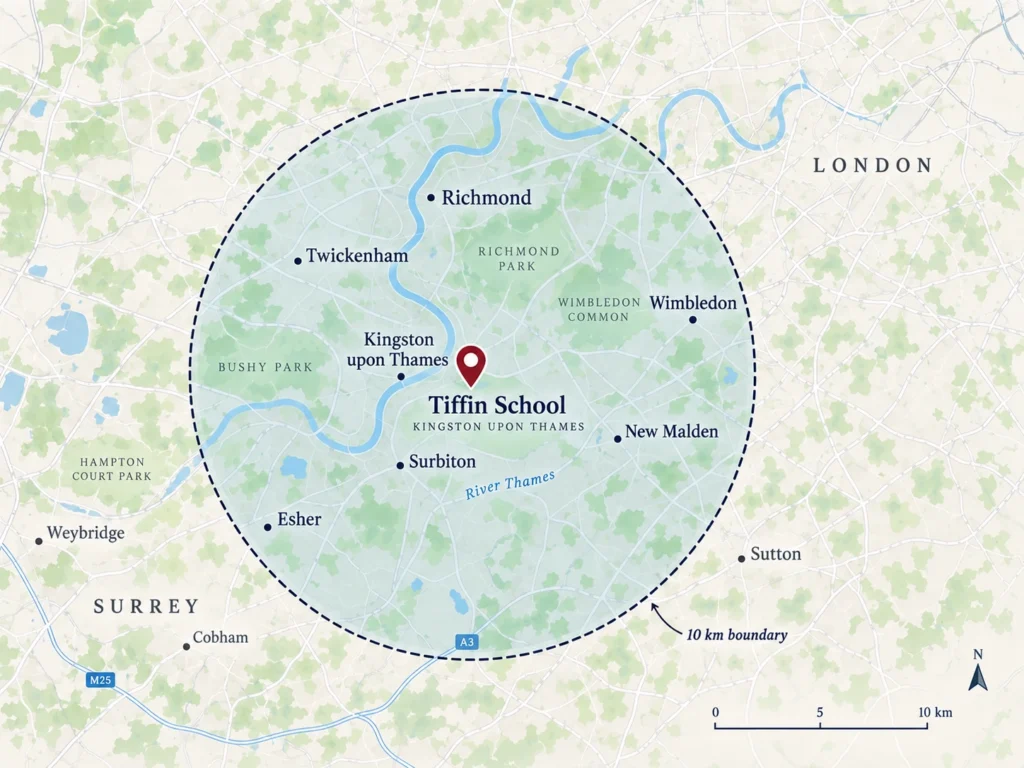
Offers are made on combined score, but where a boy lives decides which ranking he sits in. Boys living within 10 km of the school are ranked ahead of those living outside it. Distance is then used as a tie-break between boys on the same score.
Families sometimes misunderstand this point because any boy may register and sit the tests. Registration is open, but the Priority Area shapes who receives offers.
PAN and Oversubscription
Tiffin’s Published Admission Number is 180 Year 7 places, according to the school’s admissions policy for September 2027 entry. Applicant numbers run far above that every year, placing Tiffin among the most competitive state grammar routes in the country.
These figures explain why last-minute preparation rarely succeeds. Families are not competing against an average applicant pool. They are competing against a very strong and highly prepared cohort drawn from across south-west London and Surrey.
The Royal Borough of Kingston upon Thames secondary admissions guidance and the national admissions process published through GOV.UK are also important references for understanding how local authority timelines interact with the school’s own selective process.
Catchment: How Far Is Too Far?
Tiffin uses a 10 km Priority Area rather than a traditional catchment. Any boy can register and sit Stage 1, but boys living less than 10 km from the school, measured in a straight line, are ranked by score ahead of everyone living further away.
In practice, 10 km is the boundary. Since the Priority Area was introduced in 2019, every place has gone to a boy living inside it. A boy outside the Priority Area can score very highly and still not receive an offer.
That means distance matters a great deal, even though registration is open to all.
Parents should therefore check the straight-line distance from home to the school before committing to a long preparation programme. Inside the Priority Area, score decides. Outside it, Tiffin is rarely a realistic target.
Families comparing different selective-state routes may also find Grammar school admissions useful when understanding how Tiffin differs from fully selective county systems such as Kent or Sutton.
Year 5 Preparation Timeline
Preparation usually needs to begin at the start of Year 5. In autumn, the strongest focus is normally on strengthening arithmetic and problem-solving in Maths, and developing reading comprehension, vocabulary and written accuracy in English.
Autumn of Year 5
The early stage should focus on foundations. Boys need strong reading habits, secure arithmetic fluency and increasingly confident problem-solving before heavy timed preparation begins.
Spring of Year 5
By spring, boys should be working through structured practice material under increasing time pressure. Weaknesses become clearer at this stage, which allows targeted intervention before the summer period.
Summer of Year 5
Summer is usually the key mock-testing phase. Realistic practice under timed conditions becomes especially important because Tiffin’s process rewards speed, concentration and composure as much as raw ability.
October and November of Year 6
Stage 1 arrives in early October of Year 6, followed by Stage 2 for invited candidates in November. Successful boys are therefore usually those who have built consistency over time rather than relying on short-term intensive cramming.
Parents exploring wider preparation pathways may also find 11 Plus tuition useful when planning structured Year 5 preparation.
Tiffin Compared with Other Selective Routes
Families targeting Tiffin often also consider Tiffin Girls’ School for daughters, as well as Sutton selective schools such as Sutton Grammar School, Wallington County Grammar School, Nonsuch High School for Girls, and Wilson’s School.
Wilson’s in particular is often shortlisted alongside Tiffin by ambitious families with academically strong boys because both schools occupy the very top tier of state selective competition in the region.
The routes differ, though the level of preparation needed is similarly serious. Sutton consortium schools use a different admissions structure, while Tiffin’s two-stage model creates its own strategic demands.
Families comparing state selective and independent routes may also find Selective independent schools in London useful when considering wider academic options across south-west London.
Common Mistakes Families Make
One common mistake is preparing only for Stage 1 speed without building the deeper written quality needed for Stage 2. Boys who progress comfortably through Stage 1 can still struggle later if preparation has focused too narrowly on quick-answer drills.
Another mistake is underestimating the level of competition. Tiffin applicants are often extremely well-prepared, academically strong, and highly practised under timed conditions. Families who begin preparation too late frequently discover that catching up becomes difficult.
Parents also sometimes focus excessively on papers without building vocabulary, reading maturity and broader mathematical confidence. Those deeper foundations matter enormously at highly selective schools.
Finally, some families misunderstand the role of distance. Registration is open to any boy, but the 10 km Priority Area has decided who receives offers in every recent cycle.
How Lionheart Education Prepares Tiffin Candidates
Lionheart Education prepares boys for Tiffin every admissions cycle, with preparation tailored specifically to the school’s two-stage structure.
Tutors understand that Stage 1 is about breadth, speed and strong baseline performance in English and Maths, while Stage 2 rewards deeper academic quality, stronger written performance and the ability to perform calmly under much greater pressure. That difference shapes how Lionheart Education sequences preparation, combining skill-building, timed mock testing and honest admissions advice, so families understand both the academic standards required and the practical realities of admissions competition and distance.
Preparation also focuses heavily on exam composure and realistic timed performance, because many able boys lose marks due to pacing issues or pressure rather than a lack of underlying ability.
Families interested in wider pre-test preparation may also find ISEB Pre-Test tuition useful, where independent-school applications are running alongside Tiffin preparation.
FAQ’S
-
How Hard Is It to Get into Tiffin Boys’ School?
Very hard. Tiffin is heavily oversubscribed for its 180 places, and boys must first progress through Stage 1 before competing again at Stage 2.
-
What Is the Catchment Area for Tiffin Boys’?
Tiffin uses a 10 km Priority Area. Any boy can sit the tests, but those living within 10 km are ranked ahead of those outside it, and in recent years every place has gone to a boy inside the Priority Area.
-
When Should We Start Preparing for Tiffin?
Most successful families begin structured preparation at the start of Year 5, so there is enough time to build depth in Maths and English before Stage 1 in October of Year 6.
-
Is Tiffin Boys’ School Free?
Yes. Tiffin is a selective state grammar school and charges no tuition fees, although families still cover normal costs such as uniform, trips and optional extras.