The most academically selective London independent day schools for 2026 include Westminster School, St Paul’s School, St Paul’s Girls’ School, North London Collegiate School, City of London School, City of London School for Girls, King’s College School Wimbledon, Highgate School, Latymer Upper School, Dulwich College and Alleyn’s School. Entry is typically at 11+ or 13+ via the ISEB Pre-Test and school-set papers, while day fees in 2025–26 broadly range from around £25,000 to £32,000 or more each year.
For London parents considering academically ambitious independent schools, the challenge is rarely finding good options. The challenge is understanding how selective each school really is, how admissions differ from one school to another, when preparation should begin, and how fee levels fit into long-term family planning.
London has one of the most competitive independent-school markets in the world, with strong demand for places, rigorous admissions processes and significant variation in entry routes between schools. The wider sector, represented nationally by the Independent Schools Council and inspected by the Independent Schools Inspectorate, remains exceptionally broad. However, the schools at the very top of academic selectivity occupy a category of their own.
What “Selective” Means in London Independent Schools
Selective does not simply mean fee-paying. In London, selective independent schools use competitive academic testing, interviews, and, in many cases, a wider assessment of character and potential when deciding who receives an offer. These schools often have far more applicants than places, and they expect children to perform strongly against a highly able cohort.
Entry points vary considerably. Some schools admit large numbers at 11+, while others are defined more strongly by 13+ entry. Some maintain junior-school pipelines that reduce outside availability at key stages, while others recruit more openly. The result is that two schools can both be highly selective while operating very different admissions systems.
For families, understanding those systems early is one of the biggest advantages possible because timing matters just as much as academic readiness. A child who is very bright academically can still struggle if preparation begins too late or is not aligned properly to the target school’s assessment style.
Editorial authorities such as The Good Schools Guide and the Tatler Schools Guide frequently cite the same schools, reflecting how established these names are within London’s independent-school landscape.
Families comparing London’s strongest routes may also find Best prep schools in London useful, particularly where prep-school choice is linked directly to later 11+ or 13+ ambitions.
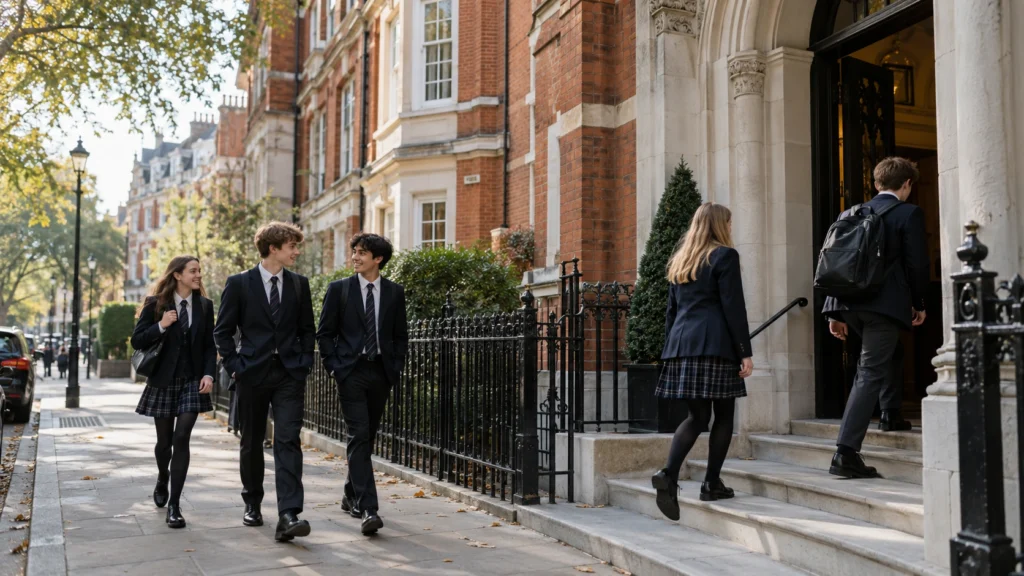
The Most Selective London Independent Day Schools for 2027 Entry
Westminster School
Westminster School remains one of the most academically selective schools in the country. The traditional route is 13+, with admissions based on the ISEB Common Pre-Test and Westminster’s own demanding assessments, followed by an interview. The Challenge is Westminster’s separate scholarship examination. Westminster’s sixth-form entry at 16+ is co-educational and also highly competitive, and girls will join at 13+ for the first time in 2028.
The school’s intellectual culture is distinctive, deeply academic, and unusually independent in spirit, making it especially attractive to academically ambitious pupils who thrive on challenge. Westminster preparation is rarely successful when approached as generic tutoring because the school’s assessment style rewards flexible thinking, intellectual curiosity and resilience under pressure rather than repetitive exam drilling alone.
St Paul’s School
St Paul’s School is similarly elite, with major entry routes at 7+, 11+ and 13+. Admissions typically combine ISEB elements with St Paul’s own papers, which are known for being searching, nuanced and demanding.
The school has a long-established reputation for scholarship-level academic stretch, particularly in Mathematics, sciences and humanities, while still maintaining impressive breadth in co-curricular life. Successful candidates are usually children who combine very secure core academics with calm analytical thinking under unfamiliar conditions.
Families targeting this route may also find St Paul’s School admissions useful when understanding how St Paul’s papers differ from broader independent-school assessments.
St Paul’s Girls’ School
St Paul’s Girls’ School is one of the most selective girls’ schools in the UK. Its 11+ route generally uses school-set English and Mathematics papers alongside an interview rather than relying heavily on ISEB testing.
Competition is intense, and successful candidates are usually exceptionally strong academically, with clear evidence of wider curiosity and thoughtful engagement beyond straightforward exam preparation. SPGS is often discussed alongside NLCS at the very sharpest end of London girls’ selectivity, particularly at 11+.
North London Collegiate School
North London Collegiate School remains one of London’s most respected girls’ schools academically, with demanding entry points and consistently strong university outcomes. The school combines traditional academic seriousness with unusually broad co-curricular opportunities, which gives it enduring appeal among highly ambitious London families.
Its admissions process varies by entry point, with combinations of school-set assessment, interview and ISEB-linked routes used depending on age of entry.
City of London School and City of London School for Girls
City of London School and City of London School for Girls are both highly competitive and widely admired for academic seriousness combined with broad opportunity.
City of London School traditionally uses a combination of ISEB and school-specific assessments, while CLSG relies more heavily on its own examination and interview processes. Both schools are particularly attractive to academically ambitious families seeking strong central London day schools without boarding options.
King’s College School Wimbledon
King’s College School Wimbledon sits firmly within the top tier of London selectivity. Entry routes at 11+, 13+ and 16+ all remain highly competitive, with admissions combining school-set tests and interviews. Girls, already admitted at 16+, will join at 11+ from September 2033.
KCS has a reputation for balancing serious academic ambition with a more relaxed atmosphere than some of London’s narrower, ultra-academic schools. That balance is one reason the school remains consistently popular with families seeking very high-level outcomes without an excessively pressured culture.
Highgate School
Highgate School has become one of London’s most sought-after co-educational independent schools. Senior School admissions at 11+ and 16+ are academically demanding, with school-set papers and interviews.
The school’s appeal comes partly from its balance of academic ambition, pastoral visibility and broad educational culture. Highgate is particularly attractive to families seeking top-tier outcomes within a co-educational setting.
Latymer Upper School
Latymer Upper School remains one of London’s strongest co-educational day schools academically. Admissions typically combine school-set English and Mathematics papers with an interview stage.
Latymer’s bursary programme also makes it distinctive within London’s independent-school sector, as academically exceptional candidates can access substantial means-tested support. Competition, therefore, extends well beyond traditional fee-paying independent-school families.
Dulwich College and Alleyn’s School
Dulwich College remains one of the capital’s leading boys’ schools, with multiple entry points and a long-established reputation for strong all-round education. Its admissions process combines school-set papers with ISEB-linked routes depending on the age of entry.
Alleyn’s School, meanwhile, has become firmly established among London’s strongest co-educational options. The school combines academic ambition with breadth and warmth, making it especially attractive to families seeking a top-level education without the narrow feel sometimes associated with ultra-selective environments.
London’s Most Selective Independent Day Schools: Entry and Fees
| School | Gender | Main entry | Admissions test | Indicative day fee (inc. VAT) |
|---|---|---|---|---|
| Westminster School | Boys (co-ed 16+; girls at 13+ from 2028) | 11+ (via Under School), 13+, 16+ | ISEB + school papers + interview | £46,000+ |
| St Paul’s School | Boys | 7+, 11+, 13+ | ISEB + school papers | £36,000+ |
| St Paul’s Girls’ School | Girls | 11+, 16+ | School-set English + Maths + interview | £37,000+ |
| North London Collegiate | Girls | 4+, 7+, 11+, 16+ | School-set + ISEB routes | £31,000+ |
| City of London School | Boys | 11+, 13+ | ISEB + school papers | £29,000+ |
| City of London School for Girls | Girls | 7+, 11+ | Own papers + interview | £30,000+ |
| King’s College School Wimbledon | Boys (co-ed sixth form; girls at 11+ from 2033) | 11+, 13+, 16+ | School papers + interview | £31,000+ |
| Highgate School | Co-ed | 4+, 7+, 11+, 16+ | School papers + interview | £32,000+ |
| Latymer Upper | Co-ed | 11+, 16+ | School-set English + Maths + interview | £31,000+ |
| Dulwich College | Boys | 7+, 8+, 10+, 11+, 13+ | School papers + ISEB routes | £30,000+ |
| Alleyn’s School | Co-ed | 4+, 7+, 11+, 13+ | School-set + reasoning + interview | £31,000+ |
Fee structures change regularly, and parents should always verify the latest figures directly through each school’s admissions or fees page before applying.
How Entry Works: 11+ vs 13+
At 11+, registration often opens in the autumn of Year 5, with examinations typically taking place in January of Year 6. Preparation, therefore, usually needs to begin well before that point, especially for highly selective schools where the applicant field is exceptionally strong.
At 13+, the timeline is longer and more layered. The ISEB Common Pre-Test often acts as an early gatekeeper in Year 6, followed later by school-specific assessments or Common Entrance pathways in Year 8. For many families, 13+ preparation is not necessarily easier than 11+; it is simply different, with more emphasis on long-term planning and steady development.
This difference matters because many London parents underestimate how early the process begins. A child targeting Westminster or St Paul’s at 13+ may effectively begin admissions preparation years before sitting final papers in Year 8.
Families working through these timelines may also find the 13 Plus Common Entrance useful for understanding how the Pre-Test, Common Entrance, and school-specific routes interact.
Fees at London’s Selective Day Schools
The broad fee range for London’s top day schools now sits at around £29,000 to £50,000 a year including VAT, with annual rises becoming increasingly common. That makes long-term planning important, especially for families with more than one child moving through the independent sector.
The 20% VAT charge on private-school fees, in place since January 2025, has also become a significant factor in family planning, with implications discussed through official UK Government guidance.
Bursaries and scholarships remain important parts of many schools’ access models, although competition for funded places is also substantial. Cost should therefore be considered as part of the admissions picture early rather than treated as a later question.
How Competitive Are London’s Top Schools?
The most selective schools in London are intensely competitive. Still, precise offer rates are often not published, and where figures are discussed publicly, they can vary by cohort, year and entry point.
What is clear is that schools such as St Paul’s Girls’, North London Collegiate, Westminster and St Paul’s School operate at the sharpest end of academic selection, with exceptionally strong candidate pools and demanding assessments.
Families often underestimate the level of competition because many applicants are already very well prepared. Success is therefore rarely about being “good” in general terms. It is about being exceptionally well prepared for that specific school’s admissions style.
Lionheart Education tutors often describe the difference this way. There is a meaningful distinction between children who are academically bright and children who are genuinely ready for Westminster-style challenge papers, St Paul’s nuance or highly competitive girls’ school interviews.

How Lionheart Education Prepares Applicants
Lionheart Education has prepared pupils for every school in this guide. Generic 11+ preparation rarely closes that gap. What does is school-specific preparation built around each school’s own demands, such as Westminster-style challenge papers, St Paul’s papers, SPGS assessment style or the varied requirements of ISEB routes.
Lionheart Education’s tutors focus on that specificity, combining one-to-one academic tuition, interview preparation and targeted mock assessments so that children are not simply bright, but genuinely ready for the exact admissions process they will face.
Preparation includes school-specific English and Mathematics work, reasoning development, interview coaching and strategic guidance on realistic school targeting. This is particularly important in London because schools that appear similar externally can test in very different ways internally.
Families considering broader preparation routes may also find ISEB Pre-Test preparation useful when planning towards competitive 11+ and 13+ independent-school entry.
FAQs
-
What are the most selective independent schools in London?
St Paul’s, St Paul’s Girls’, North London Collegiate and Westminster are widely regarded among the most selective, alongside leading schools such as King’s College School Wimbledon, Highgate and Latymer Upper.
-
When should you start preparing for 11+ in London?
Many families begin structured preparation at the start of Year 5, although timing depends on target schools, starting point and how competitive the intended route is.
-
How much are fees at London’s top independent day schools?
Indicative fees broadly range from around £25,000 to over £32,000 a year, with further rises common year to year. Scholarships and means-tested bursaries are available at many schools.
-
Do all London independent schools use the ISEB Pre-Test?
No. Many do, particularly at 11+ or 13+, but several leading schools use their own school-set papers and interviews instead.