When homeschooling A-levels in the UK, students sit their exams as private candidates at registered exam centres. Pearson Edexcel International A-levels are often the most accessible route because practical work in sciences is assessed through written examination rather than an in-school practical endorsement. UK domestic A-level sciences require a practical endorsement completed under supervision at a centre with laboratory facilities, which many private candidates cannot easily access. Hence, International A-level routes are often the simplest solution for science subjects.
For home-educating families with post-16 students, A-level study can feel like the point at which homeschooling becomes much more complex. At the GCSE stage, there are already logistical considerations. However, A-levels add greater academic depth, fewer private-candidate options in some subjects, and much greater emphasis on university progression.
The good news is that homeschooling A-levels is entirely realistic, and many students succeed through this route each year. Success depends on understanding exam boards, choosing viable subjects, securing a centre early and building a study structure that is genuinely sustainable over two demanding years.
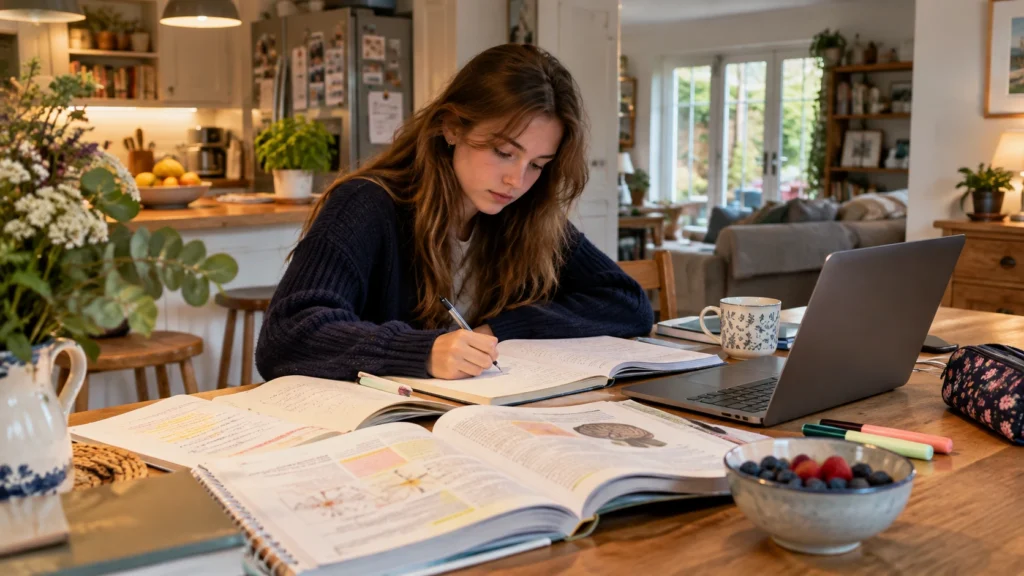
The Reality of A-levels as a Homeschooler
From a legal point of view, there is no barrier to home-educated students taking A-levels. Department for Education guidance on GOV.UK makes clear that young people over compulsory school age can continue to be educated at home to meet the requirement to stay in education or training until 18. The challenge is not legality. The challenge is logistics.
Exam-centre access is often the first hurdle. Not every approved centre accepts private candidates, and centres that do may only offer certain boards or subjects. Science practical endorsement is the second hurdle because domestic science A-levels require supervised practical assessments in a laboratory setting. The third challenge is academic intensity. A-levels demand independent reading, analytical writing and subject mastery at a much higher level than GCSE, which means students usually need a clearer timetable and stronger subject-specific support.
Families who plan early generally find the route much smoother. The most successful home-educated A-level students usually have a clear subject plan, confirmed exam-centre arrangements and a realistic weekly structure long before final exam year pressure begins.
Families stepping up into sixth-form study may also find our homeschooling GCSEs useful for seeing how private-candidate GCSEs or IGCSEs lead into A-level routes.
Which A-level Boards Accept Private Candidates?
The most important decision many homeschool families make is choosing the right exam board route. Private-candidate access varies significantly by board, subject and centre, so families should not choose subjects in isolation before checking how exams will actually be sat.
Pearson Edexcel International A-level
Pearson Edexcel International A-levels are widely regarded as one of the strongest private-candidate routes, particularly for science subjects. Biology, Chemistry and Physics all assess practical understanding through written examination papers rather than requiring an in-school practical endorsement. That removes the single biggest logistical difficulty facing private candidates.
International A-levels are also widely accepted by UK universities, including highly selective institutions, which makes them a practical and academically respected route. For homeschoolers aiming for Mathematics, Economics, English Literature, History, or the sciences, this route often provides the clearest structure.
Domestic A-level Boards
AQA A-levels, OCR A-levels and domestic Pearson Edexcel A-levels are also available to private candidates in some subjects, though access is often more limited. Humanities and essay-based subjects are generally easier to arrange because they do not require practical endorsement.
Sciences are harder because the practical endorsement has to be completed under supervision, either at a centre with laboratory facilities or through a specialist lab provider the centre works with, and many private-candidate centres cannot offer it. A student can sit the written papers without it and have the endorsement recorded as Not Classified, but many science and medicine courses ask for a Pass. This does not make A-levels in the UK impossible. It simply makes them more complicated, particularly for Biology, Chemistry and Physics.
Students weighing up qualification routes may also find it useful to A-level exam boards when deciding between an International and a domestic route.
A-level Options for UK Homeschoolers
| Board | Private candidate | Science practicals | UK university acceptance |
|---|---|---|---|
| Pearson Edexcel International A-level | Yes, widely | Written practical papers | Accepted across the UK |
| AQA domestic A-level | Limited, humanities easier | Supervised endorsement at a centre or lab provider | Accepted |
| OCR domestic A-level | Limited, humanities easier | Supervised endorsement at a centre or lab provider | Accepted |
| Pearson Edexcel A-level | Limited | Supervised endorsement at a centre or lab provider | Accepted |
Private-candidate availability varies by centre and subject, so families should always confirm details directly before building a final plan.
Finding an A-level Exam Centre for Private Candidates
Finding a centre should happen early because availability is more limited than many parents expect. Private-candidate centres commonly charge around £300 to £450 per A-level for written subjects, and domestic sciences entered with the practical endorsement can cost well over £1,000. For a student taking three A-levels, exam entry alone can therefore become a significant part of the overall budget.
Families often begin with the JCQ private candidate centre finder, which Pearson, AQA and OCR all point to, and then contact centres directly to confirm they accept private candidates in the required subject. The list is not complete, so a centre that is not listed may still take private candidates, and International A-levels are best asked about directly.
Community organisations such as Education Otherwise and community-maintained resources such as the HE Exams Wiki can also help families identify practical options. However, direct confirmation with centres is always essential because arrangements change.
The earlier centre planning happens, the less stressful the final registration process becomes. Families should confirm not only whether the centre offers the subject, but also which specification it uses, what deadlines apply, if any coursework or oral components can be supervised and what additional administration costs may be charged.
Subject Choice for Homeschoolers
Some A-level subjects fit home education especially well. Mathematics and Economics are assessed entirely by written papers on every route, and English Literature and History are too at International A-level. Domestic English Literature and History include a coursework component that the centre must agree to supervise, and Modern Foreign Languages need a centre that can run the speaking exam. All of these translate naturally into independent study supported by tuition where needed.
Sciences can also work well, though route selection matters. International A-level sciences are often the most practical option because of their written practical assessment structure. For Medicine, Veterinary Medicine, or highly selective science courses, families should always carefully verify individual university requirements, particularly where practical components are involved.
Subject choice should combine academic strength, university aims, and access to practical exams. A student may love a subject, but if the exam route is difficult to arrange privately or if the subject combination does not support intended university courses, the plan may need adjusting.
Families comparing cost and practicality may also find our guide to the cost of homeschooling in the UK helpful when budgeting for tuition, exam fees and resources across the post-16 years.
Universities and Homeschool A-levels
UK universities accept A-levels achieved by private candidates in the same way they accept A-levels achieved through school. Applications are made through UCAS in the normal way, and both domestic A-levels and Pearson Edexcel International A-levels are widely recognised. For most degree courses, the qualification route itself is not the issue. Universities care about grades, subject suitability and overall academic profile.
For Oxbridge, Medicine, and other highly competitive courses, students may need careful support with references, admissions tests, and wider application evidence, though this is manageable with good planning. A home-educated student may need a tutor, exam centre, online provider or other appropriate academic referee to support the UCAS application, depending on how the study has been organised.
Home education is not a barrier to university entry when the academic pathway is built thoughtfully. The key is ensuring that subject choices meet course requirements and that the student has credible predicted grades, strong references and evidence of academic readiness.
Costs of A-levels at Home
Exam fees often sit between £300 and £450 per subject at private-candidate centres, with domestic sciences costing more once the practical endorsement is added. Textbooks and curriculum materials may add £80 to £250 per subject, and tutoring can become the largest variable cost depending on how much specialist teaching is needed. A student pursuing three demanding A-levels with regular tutoring may create a substantial annual budget, while a highly independent student using targeted support only where necessary may keep costs much lower.
The key is to match spending to educational needs rather than assuming every subject requires intensive outside help. Some students need weekly teaching in all three A-levels. Others need a lighter model, perhaps with independent study supported by marked essays, past-paper feedback or intensive revision blocks before exams.
Families should also budget for hidden costs such as centre administration charges, late entry fees, resit fees, travel to exam venues, textbooks, online resources and, where relevant, university admissions-test preparation.
Building a Sustainable A-level Study Structure at Home
A-levels require a different level of consistency from GCSEs. Students need more independent reading, more extended written work, more sophisticated problem-solving and more regular review. A flexible homeschool timetable can work very well, but it must still provide enough academic rhythm to keep progress on track.
A good structure usually includes weekly subject blocks, independent consolidation, timed practice and regular assessment. Essay subjects need written feedback. Mathematics and sciences need frequent problem-solving and careful correction. Languages need speaking, listening, reading and writing practice rather than workbook study alone.
Parents should also build in review points across the year. It is much easier to correct a weak study structure in October than to discover in March that a student has not completed enough past-paper work or has misunderstood part of the specification.
Common Mistakes to Avoid
One common mistake is choosing domestic A-level sciences without checking whether practical endorsement can realistically be completed. This can create major problems later, especially for students applying to courses that expect practical competence.
Another mistake is assuming that, because a student is bright and independent, they will naturally manage A-level study on their own. Some students can, but many need structure, deadlines and expert feedback, particularly in essay subjects and advanced Mathematics.
Families also sometimes leave exam-centre planning too late. Private-candidate places can be limited, and deadlines may arrive earlier than expected. The centre should be confirmed before the final study plan is locked.
Finally, students should not choose subjects purely because they seem easy to organise. University progression matters. A homeschool A-level programme should be practical, but it also needs to keep the student’s future options open.

How Lionheart Education Supports Homeschool A-level Candidates
Lionheart Education supports home-educated A-level students across both International and domestic routes. Tutors are matched carefully by subject, board and university ambition, and can support International A-level Chemistry, domestic A-level History or a mixed programme built around private-candidate access.
Support can include weekly teaching, essay feedback, mock-paper marking, revision planning and university-application guidance, including personal statements and admissions preparation. Because Lionheart Education works flexibly on a pay-per-session basis, families can build support around what is genuinely needed rather than committing to expensive fixed programmes.
That flexibility is particularly valuable for homeschool families because the required support often changes across the year. A student may need regular instruction early in the course, then more intensive mock-marking and exam techniques later. Another may need short-term help choosing the correct qualification route before continuing more independently.
Families looking for broader post-16 support may also find our A-level tuition useful when deciding how to combine independent study with specialist teaching.
FAQ’S
-
Can You Do A-levels at Home?
Yes. Home-educated students can sit A-levels as private candidates through approved exam centres, and many families use International A-level routes because they are often easier logistically.
-
How Do You Find an A-level Exam Centre as a Private Candidate?
Start with the JCQ private candidate centre finder, contact centres directly to confirm private-candidate acceptance, and check fees, subject availability and deadlines early.
-
Do Universities Accept A-levels from Homeschoolers?
Yes. UK universities accept both domestic and International A-levels achieved as a private candidate, provided subject requirements are met.
-
Can You Do A-level Sciences at Home?
Yes, though International A-level sciences are often the easiest route because practical skills are assessed through written papers rather than requiring a supervised endorsement.