To prepare well for an independent school interview at 11 Plus, help your child become comfortable explaining their thinking on genuine interests rather than rehearsing polished answers. Most interviews are fifteen to thirty-minute conversations, usually one-to-one, designed to explore reasoning, curiosity, communication and fit. Children should learn how to handle follow-up questions, how to use “I’m not sure, but my first thought is…” as a starting point for reasoning, and how to speak naturally about books, hobbies and ideas that genuinely interest them.
Why Interview Preparation Feels Different from Exam Preparation
For many parents, interview preparation feels difficult because it is much less concrete than preparing for an exam paper. You can clearly revise fractions, vocabulary or reasoning patterns, but preparing a child to sit in a room with an experienced interviewer and respond thoughtfully under pressure feels more elusive.
The answer is not to script responses or drill stock questions until answers sound memorised. The answer is to help children become better conversational thinkers: children who listen carefully, respond honestly, develop ideas, and remain calm when challenged to think more deeply.
That is what many top independent schools are really looking for. What top independent schools are looking for in candidates (TO: Internal blog) provides useful further reference for families trying to understand the broader admissions picture.
What the Interview Actually Is
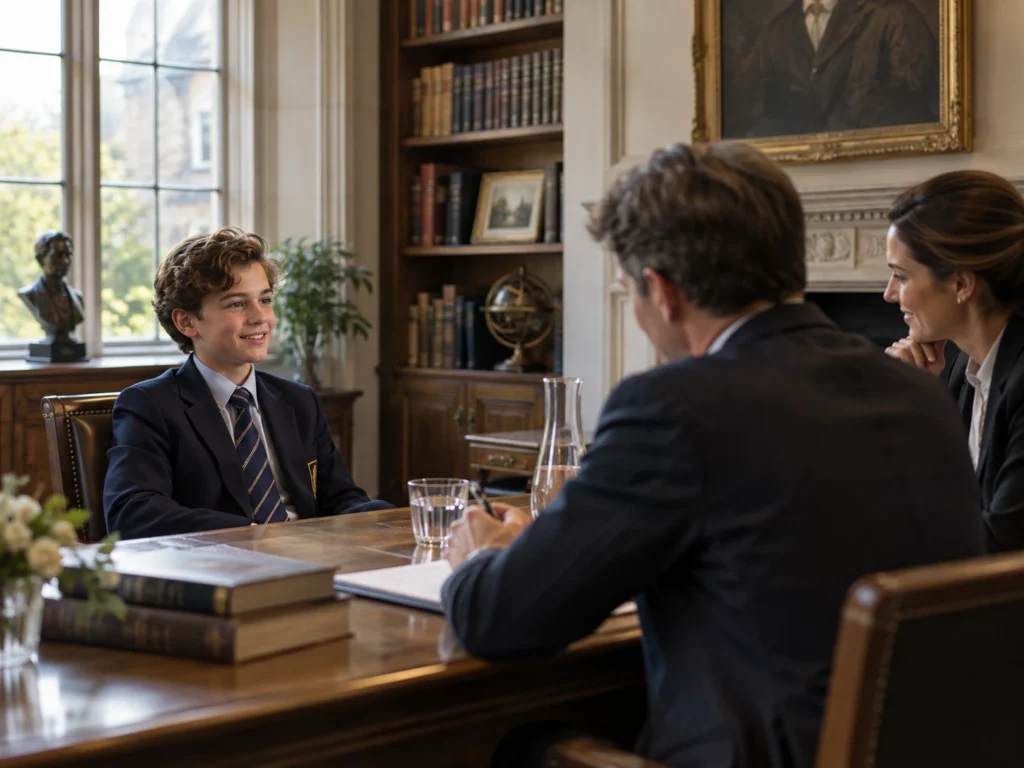
Independent school interviews are usually much less formal and much more revealing than families expect. Most are structured conversations lasting between 15 and 30 minutes, though formats vary by school.
Some are held one-to-one with a teacher or admissions lead. Some, particularly in boarding contexts, may involve two or three adults in a panel conversation. A small number of highly selective schools incorporate a short reading stimulus, a puzzle, or a collaborative group element designed to reveal how children think in a less predictable setting.
What matters is that the interview is rarely a quiz with right and wrong answers. Schools are observing how the child thinks, how clearly they communicate, how naturally they engage and whether they seem like a pupil who will flourish in that environment.
The process is much more about how a child answers than what exact answer they give. The Independent Schools Council provides a useful broader context on independent schools, but families should always verify the current interview format directly with each target school.
Interview Formats by School Type
| Format | Typical school type | Duration | What is assessed |
|---|---|---|---|
| One-to-one conversation | Most day schools and many boarding schools | 15–25 minutes | Reasoning, communication and curiosity |
| Panel interview | Some boarding and competitive day schools | 20–30 minutes | Reasoning, clarity and poise under pressure |
| Conversation plus short stimulus | Highly academic schools | 20–30 minutes | Reading response, analysis and reasoning |
| Group task | Some collaborative admissions formats | 30–45 minutes | Listening, contribution and teamwork |
Families should always verify the live format used by their target school because interview structures evolve and schools regularly refine admissions processes.
What Interviewers Are Really Assessing
Interviewers are generally looking at four broad qualities.
The first is reasoning. Can the child think aloud when presented with an unfamiliar idea? Can they make sensible progress, even if they do not immediately know the answer? Schools value children who reason clearly because that reflects how they are likely to approach challenges in the classroom.
The second is communication. This includes clarity of speech, listening carefully to the question, responding directly, and building an answer thoughtfully rather than rushing into shallow points.
The third is curiosity. Interviewers often recognise very quickly whether a child is genuinely interested in ideas or merely trying to sound impressive. Authentic enthusiasm, even about a niche hobby or a favourite book, often creates a stronger impression than broad, polished lists of achievements.
The fourth is fit. Schools want children who seem likely to engage positively with what the school offers, contribute to its culture and thrive in its environment.
That is why interviews matter so much: they reveal qualities papers cannot fully show. How independent school assessments really work provides further reference on how interviews sit alongside exams, references and school reports.
The Four Most Common Interview Question Types
Most independent school interview questions fall into four broad categories.
Interest questions explore books, subjects, hobbies and passions. These are designed to reveal genuine enthusiasm and depth of thought.
Reasoning questions test how the child thinks through an unfamiliar scenario, a puzzle, or a hypothetical problem.
Current affairs questions are usually age-appropriate and aim to see whether the child notices the wider world and can discuss it sensibly.
Ethical or hypothetical questions explore judgement, empathy and reasoning by asking what a child might do in a particular situation.
Once families recognise those categories, preparation becomes much more manageable because practice can be structured around them.
20-Question Interview Bank with Approach Cues
| Question | Type | How to approach it |
|---|---|---|
| What book have you enjoyed most recently? | Interest | Explain why, not just what happened |
| Which school subject do you most enjoy? | Interest | Give a specific example of what draws you in |
| Tell me about a hobby you care about. | Interest | Show genuine enthusiasm and detail |
| If you could learn any skill, what would it be? | Interest | Explain what appeals to you |
| What do you enjoy doing when nobody tells you what to do? | Interest | Answer honestly and thoughtfully |
| Why do you think people disagree? | Reasoning | Explore both sides before concluding |
| If everyone in the world thought the same, what would happen? | Reasoning | Think about the positives and negatives |
| What makes a good leader? | Reasoning | Use examples and explain why |
| Is it better to be clever or hardworking? | Reasoning | Weigh both before giving a view |
| What problem in the world would you most like to solve? | Reasoning | Explain why it matters to you |
| Have you heard a news story recently that interested you? | Current affairs | Summarise clearly, then give your thoughts |
| Why do you think that story matters? | Current affairs | Connect it to wider consequences |
| What invention has changed life the most? | Current affairs | Choose one and explain its impact |
| What do you think schools should teach more of? | Current affairs | Give a reasoned opinion |
| What challenges do children face today that adults did not? | Current affairs | Think broadly and calmly |
| What would you do if you saw someone being left out? | Ethical | Focus on empathy and practical action |
| Should rules ever be broken? | Ethical | Recognise nuance rather than extremes |
| Is honesty always the best policy? | Ethical | Discuss situations thoughtfully |
| If you made a serious mistake, what would you do next? | Ethical | Show accountability and reflection |
| What responsibility comes with talent? | Ethical | Think about contribution and humility |
These questions are best used as conversation starters, not memorisation exercises.
How to Practise Without Over-Coaching
The strongest interview preparation usually happens in an ordinary family conversation. Discuss one book a week in depth at dinner rather than simply asking whether it was good. Ask why a character behaved in a certain way, what surprised your child, or whether the ending was satisfying. Those conversations quietly build the ability to explain ideas naturally.
Introduce gentle follow-up questions. If your child says they love science, ask which area fascinates them most and why. If they mention football, ask what makes a good captain or what they have learned from being part of a team. This teaches children to develop answers rather than stop after one sentence.
Encourage comfort with uncertainty, too. “I’m not sure, but I think…” is often the beginning of an excellent interview answer because it shows honest reasoning rather than panic.
One short mock interview in the fortnight before the real interview can be useful. Repeated formal mock interviews often create stiffness, and stiffness is exactly what schools notice.
Preparing for School-Specific Formats
Some schools keep the interview very conversational. Others may add a short reading passage, an object discussion, a mental maths prompt, a logic puzzle, or a group task. Families should therefore prepare broadly but lightly.
For schools using broader assessment routes, the ISEB Common Pre-Test can sit alongside interviews, school references and school-set tasks. What is the ISEB pre-test and how does it work? and How to prepare for the ISEB pre-test provide useful further reference for families preparing for schools that combine online testing with interview assessment.
On the Day
Children should arrive early enough to feel settled rather than rushed, ideally around fifteen minutes before the interview time. Clothing should follow the school’s guidance, whether that is smart dress or a school uniform. If the child has referred to a favourite book, project, or interest in an application, they should be ready to talk about it naturally and in detail.
Most importantly, children should pause before answering. A thoughtful pause looks confident, not uncertain. Good interviewers are comfortable with silence because it often signals that thinking is happening.
A child who listens carefully, breathes, and answers thoughtfully usually comes across very strongly.
Common Interview Mistakes
The most common mistake is sounding rehearsed. Polished opening lines and memorised speeches rarely feel natural.
Another mistake is rushing to answer before thinking. Fast answers are not usually impressive if they are shallow.
Children also often make the mistake of giving five brief points instead of developing one clear idea properly. Depth nearly always creates a stronger impression than breadth.
Finally, pretending to know something they do not know is almost always damaging. Honest, thoughtful reasoning is far more persuasive than bluffing.
How Lionheart Education Prepares Pupils for Interviews
Lionheart Education prepares pupils for independent school interviews through realistic, school-matched mock formats rather than generic coaching. Children practise one-to-one conversations, panel-style questioning, and reasoning discussions in ways that feel authentic to real admissions settings.
Alongside that, Lionheart Education’s broader teaching approach develops explanation, thoughtful discussion, and intellectual confidence throughout academic preparation, so interview skills grow naturally rather than being bolted on at the last moment.
That creates children who sound like themselves at their best: thoughtful, articulate and genuinely engaged, which is exactly how strong candidates tend to stand out.
FAQ’S
-
What happens in an independent school 11 Plus interview?
Usually, it is a fifteen to thirty-minute conversation, often one-to-one and sometimes with a panel, designed to explore reasoning, communication, curiosity and fit.
-
What questions are commonly asked?
Questions usually fall into four groups: interests, reasoning, current affairs and ethical or hypothetical scenarios.
-
How should children prepare?
Children should practise thoughtful conversation, discuss books and ideas, and become comfortable in naturally explaining their reasoning.
-
Should children memorise answers?
No. Interviewers recognise memorised answers quickly and usually prefer authentic, thoughtful responses.
-
What matters most in an independent school interview?
Listening carefully, thinking calmly and developing one clear idea well usually matter more than rushing into shallow answers.