A strong 11 Plus reading list is rarely built around one type of book. The most effective reading diet combines accessible modern fiction, literary stretch texts, carefully chosen classics, non-fiction and regular poetry. Children should move gradually up that ladder rather than leaping straight into books that feel like hard work, because the aim is to build vocabulary, inferential skills, comprehension stamina, and written expression while still protecting enjoyment.
Why Reading Matters For The 11 Plus
Many parents understandably ask which books are best for the 11 Plus, but a more useful question is which books are best for where a child is now, and which books should come next. Reading should form part of a wider 11 Plus preparation plan, helping children develop gradually rather than simply completing more practice papers. It should stretch children, expose them to richer language over time and build confidence rather than making reading feel like another weekly test.
Reading underpins almost every area of 11 Plus English. Vocabulary grows most naturally through repeated exposure to words in context. A child who encounters words such as reluctant, wary, resigned or determined in a story begins to understand shades of meaning that vocabulary lists alone rarely teach properly. Over time, this creates the sort of language instinct that supports comprehension, verbal reasoning and written expression, and is one of the qualities tutors look for in strong 11 Plus students.
Reading also builds comprehension stamina. Many children are perfectly capable readers in everyday life. Yet, struggle when asked to sustain concentration through a demanding passage, hold details in memory and answer layered questions under time pressure. Regular reading quietly trains that concentration.
The National Literacy Trust continues to highlight the strong relationship between reading frequency, vocabulary growth and wider academic outcomes, which is one reason reading remains such a powerful long-term lever in educational development.
For 11 Plus candidates, a useful aim is often reading maturity above chronological age by exam time, particularly for more demanding grammar-school and independent-school routes. How to improve 11 Plus English comprehension provides further reference on how reading connects to exam performance.
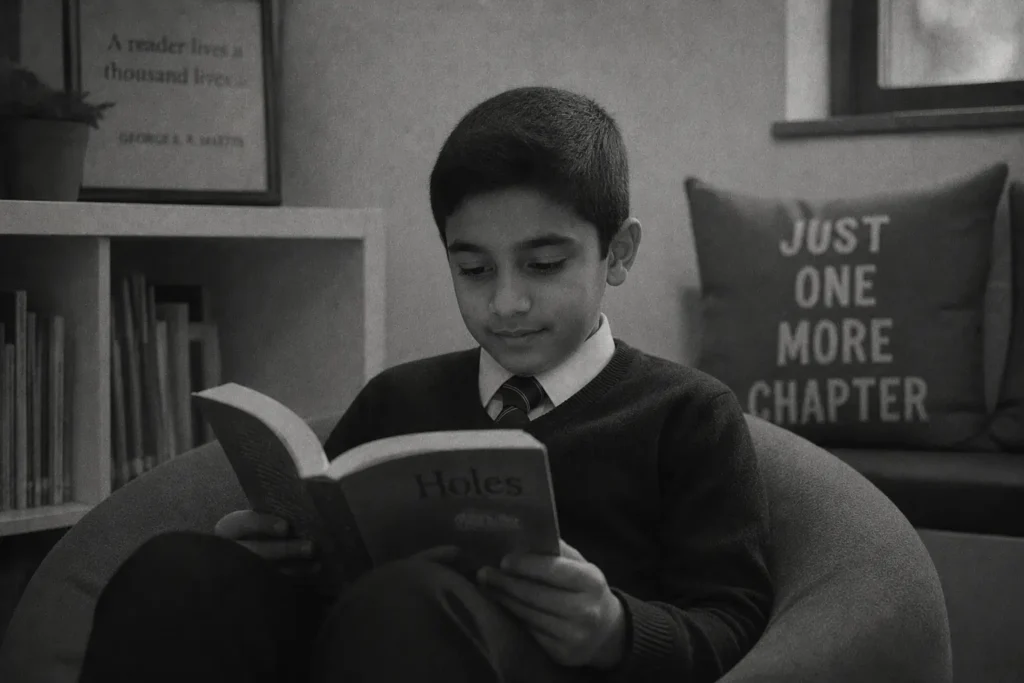
Reading Ladder For 11 Plus Preparation
| Stage | Approximate reading level | Example books | What it builds |
| Accessible fiction | Confident lower KS2 | Charlotte’s Web, The Lion, the Witch and the Wardrobe, Roald Dahl | Reading habit and basic inference |
| Modern stretch | Strong Year 4 / Year 5 | War Horse, The Explorer, His Dark Materials | Vocabulary, stamina and richer description |
| Literary stretch | Year 5 / Year 6 | E. Nesbit, C. S. Lewis, A Christmas Carol | Older syntax and layered language |
| Classics | Strong Year 6 and above | Oliver Twist, The War of the Worlds, The Hobbit | Formal language and complex narrative |
| Non-fiction | Year 5 onwards | Biographies, newspaper features, Horrible Histories | Factual inference and unfamiliar topics |
| Poetry | All stages | Ted Hughes, Carol Ann Duffy, children’s poems | Close reading and figurative language |
This ladder matters because jumping too far too quickly can switch children off reading altogether. Progression works better than shock therapy.
LoveReading4Kids and BookTrust both provide useful age-banded recommendations to help parents gauge where a child currently sits before choosing stretch texts.
Modern Fiction That Helps 11 Plus English
Modern fiction remains one of the best entry points because it keeps reading pleasurable while still offering strong language development. Authors such as Michael Morpurgo and Katherine Rundell are particularly valuable because they write beautifully without becoming inaccessible.
War Horse offers emotional depth, historical setting and strong opportunities for inference. The Explorer gives pupils rich descriptive writing, atmosphere and survival themes without the language becoming too archaic. Philip Pullman’s His Dark Materials offers another excellent step up, particularly for pupils who enjoy longer narratives and are ready for greater complexity.
Modern fiction is often the best place to build momentum. If a child enjoys reading, they will read more; if they read more, vocabulary and comprehension stamina improve more naturally.
Literary Stretch Texts And Classics
Literary stretch texts are especially useful once a child is reading confidently but needs richer language. C. S. Lewis introduces children to slightly older rhythms of writing, while E. Nesbit offers elegant storytelling with stronger vocabulary and more layered sentence structure.
Short Dickens is extremely useful. Rather than beginning with a very long Victorian novel, A Christmas Carol is often the perfect gateway into Dickensian language because it is short, vivid and full of atmosphere.
From there, stronger readers can move on to Oliver Twist, The Hobbit, and The War of the Worlds. Each stretches comprehension differently, whether through older syntax, formal narrative voice or denser descriptive writing.
This kind of reading also helps children become more comfortable with classic-style extracts, which often appear in selective-school comprehension practice. How 11 Plus papers are really designed may help families understand why exposure to different text styles matters.
Non-Fiction And Poetry Matter Too
Many parents focus heavily on fiction, but strong 11 Plus readers also need a range of books. High-quality children’s biographies, newspaper feature writing, accessible science writing, and history-based narrative nonfiction all help children become comfortable with unfamiliar subjects and with factual interpretation. That matters because comprehension passages are not always stories.
Series such as Horrible Histories can be excellent bridges between entertainment and factual reading, while age-appropriate newspaper features introduce a more mature style of informational writing.
Poetry should also have a regular place in the reading diet. Short poems train close reading better than almost any other medium because every word matters. Children become more sensitive to imagery, rhythm, tone and figurative meaning, all of which strengthen comprehension skills.
The Carnegies shortlist and winners’ lists are useful places for parents seeking consistently high-quality children’s literature.
Building Vocabulary Through Reading
Reading builds vocabulary best when children interact with words rather than skim past them. A very effective habit is keeping a small word log containing three to five new words per day. Instead of immediately reaching for a dictionary, children should first try to work out the meaning from context.
Then they should deepen the word by asking what it means, what a synonym might be, what its opposite is and whether they can use it tomorrow in speech or writing.
For example, a child might record reluctant as meaning unwilling or hesitant, link it to synonyms such as hesitant, wary and cautious, and contrast it with eager. They might then write a sentence such as: “He was reluctant to answer because he was unsure.”
That kind of active vocabulary work creates lasting gains far more effectively than rote memorisation. How to build vocabulary for the 11 Plus provides further guidance for families seeking a more structured vocabulary routine.
How To Use Reading Alongside 11 Plus Preparation
Reading should support preparation, not become preparation itself. Children still need explicit comprehension practice, vocabulary work and exam technique. Reading provides the raw material for those skills.
A useful rhythm is daily reading for pleasure, short vocabulary discussion, occasional “why” or “what does this suggest?” questions and structured comprehension practice alongside genuine reading.
The mistake many families make is turning every book into work. Children still need to read simply for enjoyment because enjoyment protects habits, and habits drive long-term improvement.
BBC Bitesize KS2 reading resources can support discussion and comprehension techniques alongside independent reading, but they should not replace the habit of reading full books.

Common Mistakes Parents Make With 11 Plus Reading
Most parents supporting an 11 Plus child want to help with reading, but the instincts that feel productive are not always the ones that build a strong reader. A few habits in particular tend to slow progress rather than support it, and they are easy to adjust once spotted.
Starting With Books That Are Too Hard
A difficult classic may look impressive, but if a child finds every page exhausting, the habit may collapse. It is better to build steadily than to force a book that creates resistance.
Treating Every Chapter As Comprehension Work
Occasional discussion is useful, but constant questioning can make reading feel like a test. Children need space to become absorbed in books.
Ignoring Non-Fiction
Many 11 Plus passages are factual, historical or descriptive rather than purely fictional. Non-fiction helps children become comfortable with unfamiliar topics and formal explanations.
Focusing Only On The Plot
Plot matters, but 11 Plus English also rewards attention to tone, vocabulary, atmosphere, character motive and implication. These should be discussed gently as part of reading.
How Lionheart Education Supports Stronger Reading Habits
Children who read widely almost always develop stronger instincts for language, a richer vocabulary and better judgement in comprehension over time. The key is choosing books that are both enjoyable and stretching, then building steadily from there.
Lionheart Education helps families make reading a purposeful part of preparation. We link carefully chosen books with vocabulary work, comprehension teaching and exam technique, so reading becomes more than a good habit. It becomes a practical advantage in the 11 Plus. Children who need more targeted support can also work with one of our specialist English tutors.
FAQ’S
-
What books should my child read for the 11 Plus?
A balanced mix of modern fiction, literary stretch texts, classics, non-fiction and poetry works best. Children should move gradually up a reading ladder rather than jumping straight into very difficult books.
-
How does reading help with the 11 Plus?
Reading strengthens vocabulary, inference, concentration, written expression and familiarity with richer language. It also builds stamina for longer comprehension passages.
-
Should children read classics or modern books?
Both are useful. Modern books often build confidence and enjoyment, while classics stretch vocabulary, syntax and formal language. The best approach is gradual progression.
-
How much reading is needed?
Twenty to thirty minutes daily is usually far more effective than occasional long sessions. Consistency matters more than intensity.
-
Can reading alone improve English performance?
Reading builds the foundation, but exam technique and explicit comprehension practice still matter. Children need to learn how to apply reading skills to retrieval, inference, vocabulary and written-answer questions.